The Shift From Visibility to Trust
Dubai does not reward visibility alone anymore.
Every industry is saturated with brands that look polished, sound confident, and promote aggressively. Real estate, consulting, wellness, finance. The surface level is high across the board, which means differentiation no longer comes from how loud a brand is, but from how clearly it is understood.
That shift changes how content works.
Promotional messaging was built for a different environment. It assumes attention is available, comparison is limited, and urgency can drive decisions. None of that reflects how people behave today. Audiences research more, question more, and filter faster. In many cases, they form opinions before ever speaking to a company.
Because of that, content has taken on a new role.
It no longer introduces a brand. It validates it.
Search behavior reflects this clearly. Google’s own guidance on creating helpful, reliable, people-first content makes one thing explicit: content created primarily to attract clicks is no longer the standard that performs
https://developers.google.com/search/docs/fundamentals/creating-helpful-content
Instead, the emphasis has shifted toward usefulness, clarity, and genuine understanding of a topic.
This aligns with the broader framework of E-E-A-T, where experience, expertise, authoritativeness, and trust determine how content is evaluated and surfaced
https://searchengineland.com/guide/google-e-e-a-t-for-seo
In practical terms, promotional content struggles to meet these criteria.
It makes claims without context, highlights benefits without explaining relevance. It assumes trust rather than building it. As a result, it often fails to support either search visibility or decision-making.
However, authority content works differently.
Rather than pushing outcomes, it clarifies how those outcomes are achieved. Instead of presenting a service as the answer, it breaks down the problem first. That approach does not slow down the decision process. It strengthens it.
In a market like Dubai, where audiences are exposed to global standards and high-quality branding daily, that distinction becomes even more important.
Trust is not built through statements, but through understanding.
Regional insights reinforce this shift. Content strategies across the GCC increasingly focus on demonstrating expertise and credibility rather than relying on direct promotion
https://www.gcc-marketing.com/en/blog/understanding-e-e-a-t-in-content-strategy-boost-your-digital-presence-with-gcc-marketing/
At the same time, SEO performance in the Middle East continues to depend on relevance, depth, and cultural alignment, particularly in multilingual environments
https://www.thewordwave.com/blogs/top-5-seo-strategies-for-arabic-content-in-the-middle-east
All of this points to the same conclusion.
Visibility gets attention, while authority earns preference.
And in a market where attention is short and options are endless, preference is what drives growth.
How Authority Content Builds Demand While Promotional Content Fades
The difference between authority and promotion becomes most visible over time.
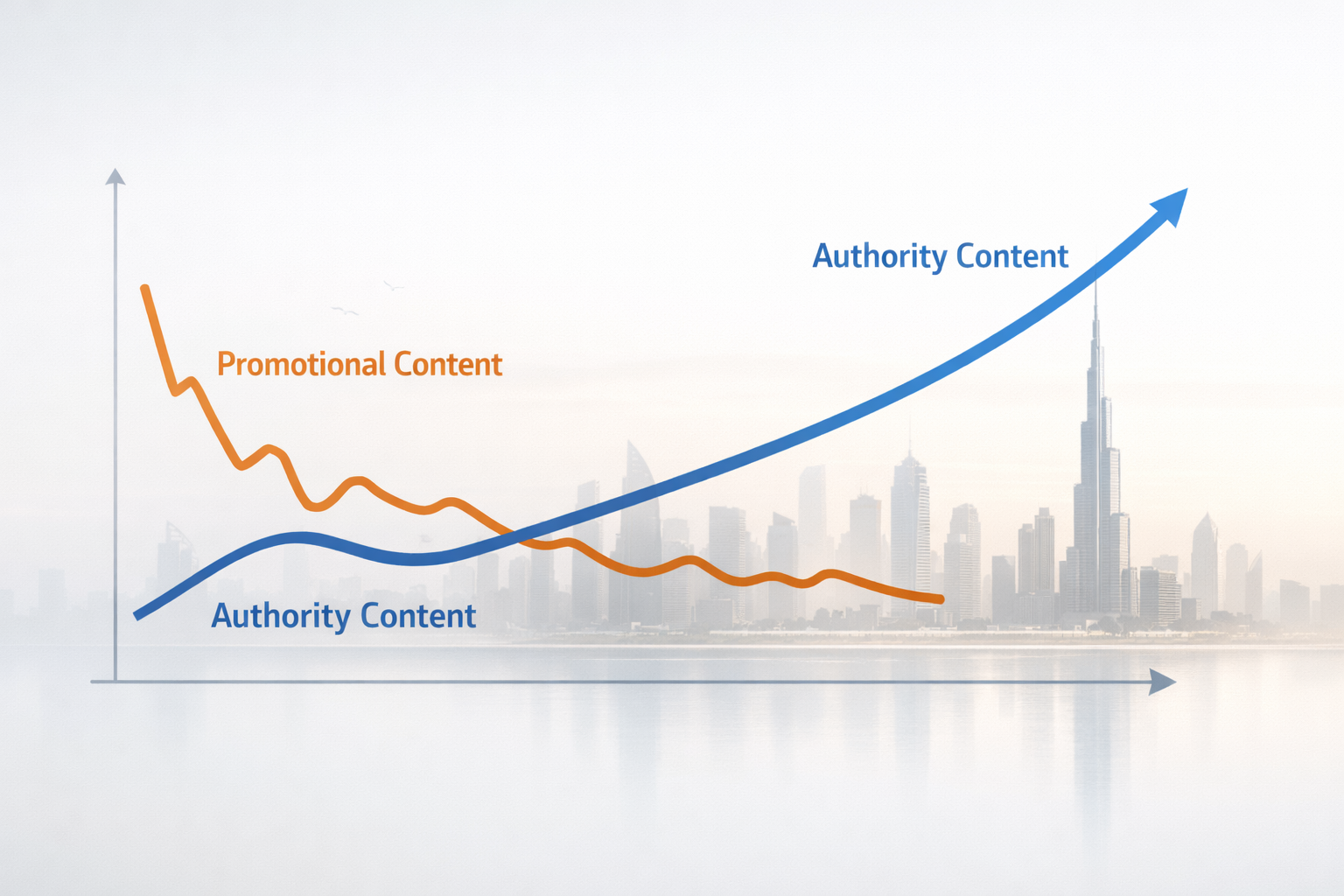
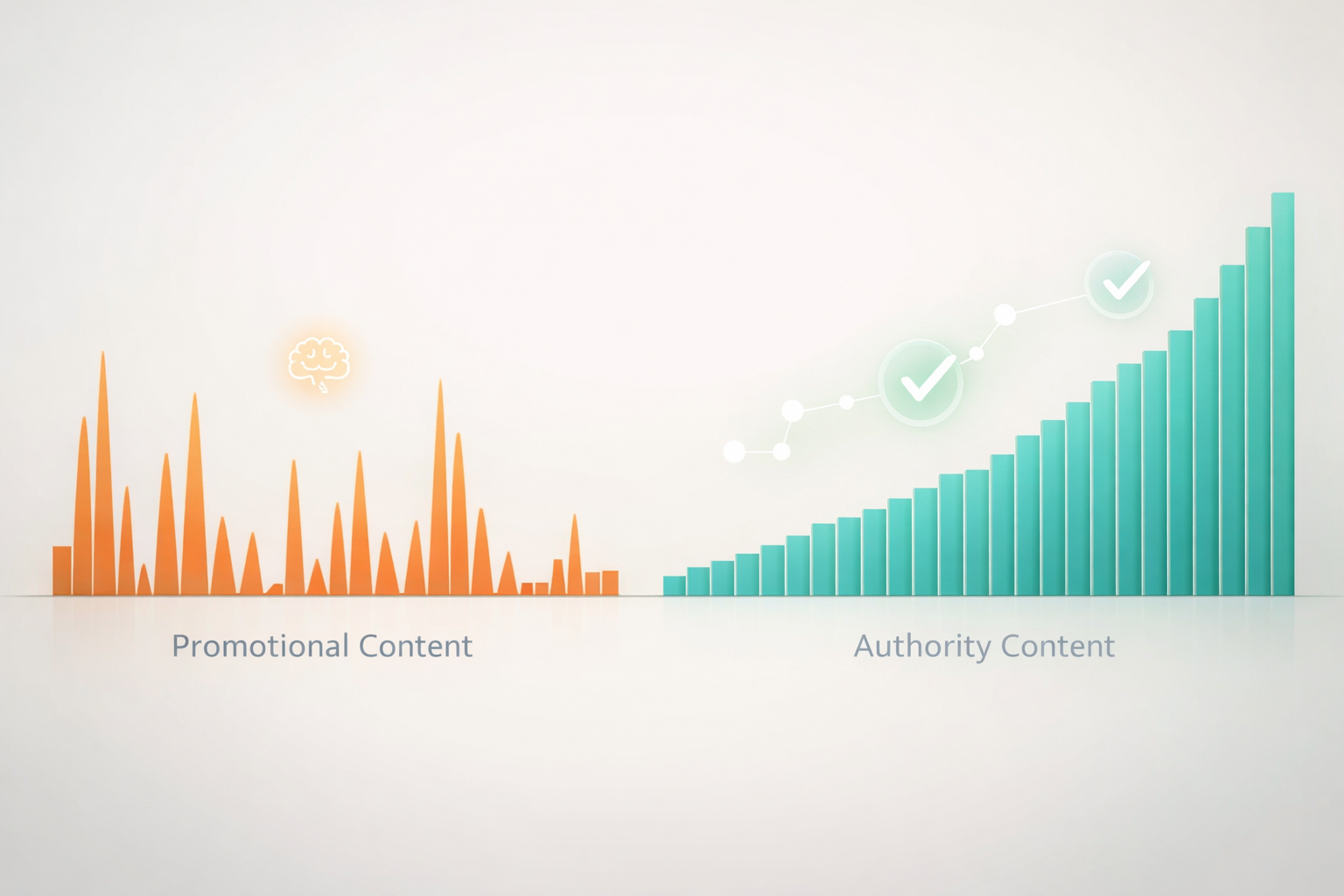
Promotional content often produces immediate spikes. A campaign launches, engagement increases, traffic rises for a short period. Then it fades. The message has a limited lifespan because it is tied to a moment rather than a perspective.
Authority content behaves differently.It compounds.
A well-structured piece of content continues to attract attention long after it is published. It answers ongoing questions, supports multiple stages of the decision process, and reinforces positioning every time someone interacts with it.
That compounding effect is one of the reasons content marketing remains central to long-term SEO performance and brand growth
https://www.verkeer.co/insights/the-role-of-content-marketing-in-a-successful-seo-strategy/
More importantly, it changes how conversion happens.
Promotional content tries to convince in a single interaction, and authority content prepares the decision before the interaction even takes place.
If people consistently encounter clear, relevant, and insightful content from a brand, hesitation decreases. Questions are already answered. Expectations are already aligned.
At that point, choosing becomes easier.
This is particularly relevant in Dubai, where purchasing decisions often involve higher investment, higher expectations, and faster timelines. They are not only evaluating what is offered. They are evaluating how confidently they can move forward.
Authority content reduces that friction.
It gives structure to the decision-making process. It highlights what matters, filters what does not, and positions the brand as a reliable reference point within that process.
By contrast, promotional content often adds pressure without reducing uncertainty. It asks for action without providing enough clarity to support it.
That gap explains why many brands remain visible but struggle to convert consistently.
The issue is not effort, but direction
Most content strategies still operate in isolation. Posts are created without connection. Campaigns are executed without continuity. Messaging shifts depending on the platform or moment.
As a result, nothing accumulates.
Authority requires consistency, but not in volume. It requires consistency in perspective. A brand becomes associated with specific ideas only when those ideas are repeated, developed, and reinforced over time.
That is where structured marketing systems become essential.
At MG Lumeo, the focus is not on isolated campaigns or short-term tactics. The work centers on building systems that connect content, SEO, and messaging into a unified direction.
That structure maintains visibility, creates consistency, supports decision-making, and reduces dependency on any single channel.
Because the reality is simple.
Markets change fast. Attention shifts. Conditions become uncertain.
Yet brands that have established clarity continue to perform.
The audience still chooses them, not because they push harder, but because they feel familiar, reliable, and easy to understand. Even in uncertain times, audiences gravitate toward what feels stable. They look for signals that allow them to continue making decisions with confidence, as if things are still moving forward in a structured way.
Authority content creates that environment.
It does not react to change. It absorbs it.
In the end, growth does not come from saying more.
It comes from being understood faster, trusted earlier, and chosen with less resistance.
Why Authority Content Matters More When Markets Become Uncertain
Market conditions do not stay stable for long.
Economic shifts, regional uncertainty, and changes in consumer behavior all influence how people make decisions. During these periods, attention does not disappear, but it becomes more selective.
However, people still buy.
However, they become more careful about who they choose.
Why Promotional Content Loses Strength Under Pressure
Promotional content depends on urgency and persuasion.
As uncertainty increases, those triggers weaken. Audiences do not respond to pressure in the same way. Instead, they pause, evaluate, and look for reassurance.
As a result, messages built around “act now” or “limited time” lose effectiveness.
The issue is not visibility.
The issue is confidence.
Authority Content Creates Stability and Trust
Authority content operates differently, and creates a sense of normality.
When a brand communicates with clarity, structure, and consistency, it signals stability. Shows that the business understands its environment and can navigate change without losing direction.
That perception directly influences decision-making, people are not only evaluating what is being offered. They are evaluating whether they feel confident choosing it.
Authority content reduces that friction.
Explains what is happening, what to consider, and what to expect. It replaces uncertainty with understanding. Over time, the brand becomes associated with clarity rather than noise.
Why Search and AI Systems Reinforce This Shift
This evolution is not only behavioral, but also technical.
Search systems increasingly prioritize content that helps users make informed decisions, rather than content designed only to attract attention
https://developers.google.com/search/docs/fundamentals/creating-helpful-content
At the same time, frameworks like E-E-A-T continue to emphasize experience, expertise, and trust as key signals for visibility
https://searchengineland.com/guide/google-e-e-a-t-for-seo
Because of that, authority content does not just feel better to the audience. It performs better across search and discovery platforms.
What Happens to Brands That Rely Only on Promotion
Authority is not built when conditions are easy, but becomes visible when conditions are uncertain.
Brands that rely only on promotion often become inconsistent. Messaging shifts, activity slows, and direction becomes unclear.
On the other hand, brands that have invested in authority maintain their presence. Their content continues to guide, explain, and support decisions without changing direction.
That continuity builds confidence.
And confidence drives action.



Social Profiles