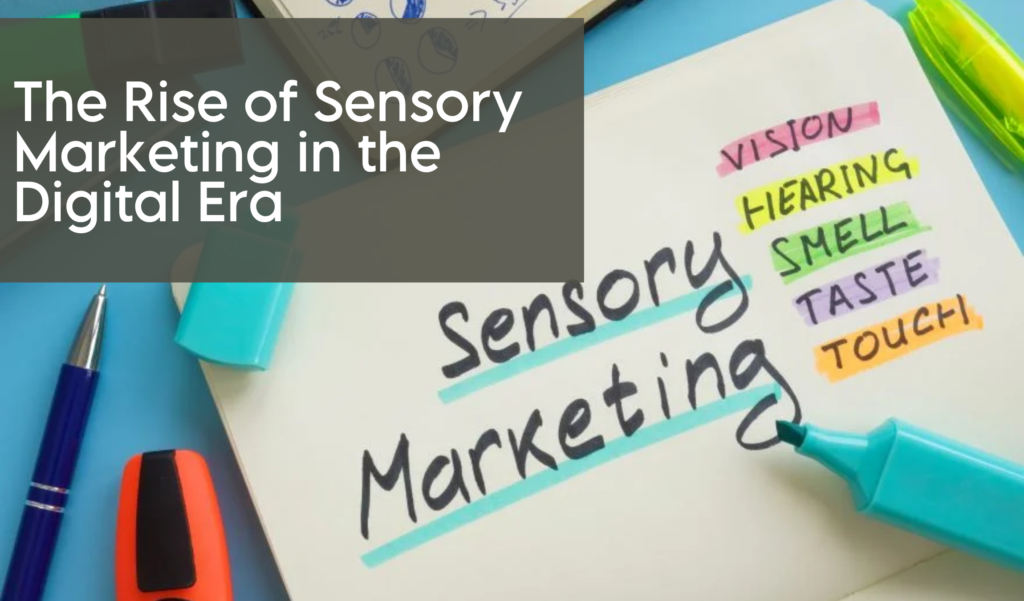
Digital environments have become increasingly saturated. Brands are producing more content than ever, yet attention spans continue to decline. Visual content alone is no longer enough to capture or hold interest.
As a result, businesses are beginning to shift how they approach digital marketing.
Instead of focusing only on what users see, they are starting to design how users experience digital interactions.
Insight: Digital Marketing Is Becoming Sensory
Sensory marketing has traditionally been associated with physical environments. Retail spaces use sound, scent, texture, and layout to influence behaviour and perception.
However, this is now extending into digital environments.
According to Forbes Communications Council, brands are increasingly using digital tools to create more immersive and emotionally engaging experiences, moving beyond purely visual communication.
At the same time, academic research such as Digital Sensory Marketing highlights how technologies now allow brands to integrate multiple sensory cues into online experiences, even without physical interaction.
The shift is clear:
Digital marketing is evolving from static visuals to multi-sensory engagement
Why Visual-Only Marketing Is Losing Effectiveness
In highly competitive markets like Dubai, users are exposed to constant streams of content. As a result, visual differentiation alone is no longer enough.
People scroll quickly. They filter aggressively. They ignore what feels repetitive.
However, when content includes:
- motion
- sound
- interaction
- pacing
users are more likely to pause.
Research on sensory cues in digital environments shows that multisensory input improves:
- attention
- emotional response
- memory retention
Studies such as those published in ACR Journal demonstrate that sensory elements directly influence trust and behavioural intent.
Business implication:
Sensory marketing is not about making content more “creative.” It is about increasing the likelihood that users notice, remember, and act.
Sensory Cues Act as Emotional Shortcuts
Digital decisions are rarely purely rational.
Users respond quickly to how something feels:
- smooth
- fast
- immersive
- engaging
These signals are often created through sensory cues rather than information.
For example:
- subtle motion creates flow
- sound enhances immersion
- micro-interactions create feedback
- visual depth simulates texture
As highlighted by Pobuca, sensory marketing is becoming a key driver of digital customer experience, shaping how users perceive and interact with brands.
This means:
Perception is not only influenced by what you say
It is influenced by how the experience feels
UX Is Becoming a Sensory Layer
Most businesses still approach UX as structure and navigation.
However, modern UX increasingly includes:
- animations
- hover effects
- transitions
- micro-interactions
These elements are not decorative. They are sensory signals.
They communicate:
- quality
- attention to detail
- brand positioning
Industry insights such as those shared by Daffodil Marketing highlight how sensory elements are shaping the future of digital interfaces and user perception.
Business implication:
A well-designed experience does not just function better. It feels more valuable.
E-commerce Is Replacing Physical Experience
In physical environments, customers rely on:
- touch
- sound
- spatial experience
In digital environments, these are absent.
However, brands are increasingly simulating them through:
- product videos
- zoom detail
- interactive visuals
- immersive storytelling
Research frameworks such as sensory marketing in digital environments explain how these cues can replicate aspects of physical experience, influencing confidence and purchase decisions.
The result:
E-commerce is no longer just transactional
It is becoming experiential
Measuring Sensory Marketing: From Experience to Performance
One of the common misconceptions about sensory marketing is that it is difficult to measure. Because it focuses on perception and experience, many businesses assume it is subjective.
However, in practice, sensory elements directly influence measurable performance.
When digital experiences are designed with sensory cues, the impact can be observed through:
- time spent on page
- interaction rates
- scroll depth
- conversion rates
- return visits
For example, adding motion, micro-interactions, or video does not only improve aesthetics. It changes how users move through a website and how long they stay engaged.
According to industry insights such as those discussed in research on sensory branding effectiveness, multi-sensory experiences tend to increase both engagement and memory retention, which are directly linked to conversion behaviour.
The key shift is this:
Sensory marketing should not be evaluated as “design improvement”
It should be evaluated as performance optimisation
This is particularly relevant in digital environments where small changes can have a measurable impact.
For example:
- a smoother transition can reduce drop-off
- a well-placed animation can guide attention to a CTA
- interactive elements can increase user engagement
- video content can improve product understanding
Each of these contributes to how effectively a digital experience converts.
At the same time, measurement requires a structured approach.
Businesses should track:
- how users interact with different elements
- where attention drops
- which pages convert better after UX improvements
This allows sensory marketing to move from a creative concept to a data-informed strategy.
The implication is clear:
Sensory marketing is not only about how a brand feels
It is about how that feeling influences behaviour
When implemented correctly, it becomes a practical tool for improving both user experience and business results.
Sensory Marketing Is a Response to Saturation
It is important to understand that this shift is not a trend.
It is a response to:
- content overload
- declining attention
- commoditised visuals
As discussed in SocialAmp, future developments such as AR and VR will further expand sensory branding, making digital experiences even more immersive.
This indicates a long-term shift:
Brands will compete not only on message, but on experience
Application: How Businesses Can Implement Sensory Marketing
Businesses do not need complex technology to begin applying these principles. The focus should be on improving how users experience digital interactions.
Practical areas include:
Websites
- Use motion and transitions to guide attention
- Add micro-interactions to create feedback
- Improve visual depth and detail
Social media
- Prioritise video over static content
- Use pacing and movement to hold attention
- Consider sound as part of the experience
Advertising
- Design ads with strong visual and motion hooks
- Use short, engaging sequences instead of static visuals
Brand consistency
- Maintain consistent visual and experiential cues across platforms
- Ensure the brand “feels” the same everywhere
The goal is not complexity
The goal is intentional experience design
Positioning: The Role of Experience in Modern Marketing
As digital environments evolve, the way people evaluate brands is changing.
It is no longer based only on:
- information
- price
- visibility
It is also based on:
- experience
- perception
- interaction
At MG Lumeo, the focus is not only on creating content.
It is on designing structured digital experiences that:
- capture attention
- create engagement
- influence perception
- support decision-making
Because in increasingly saturated environments, the brands that stand out are not only seen.
They are felt.






Social Profiles