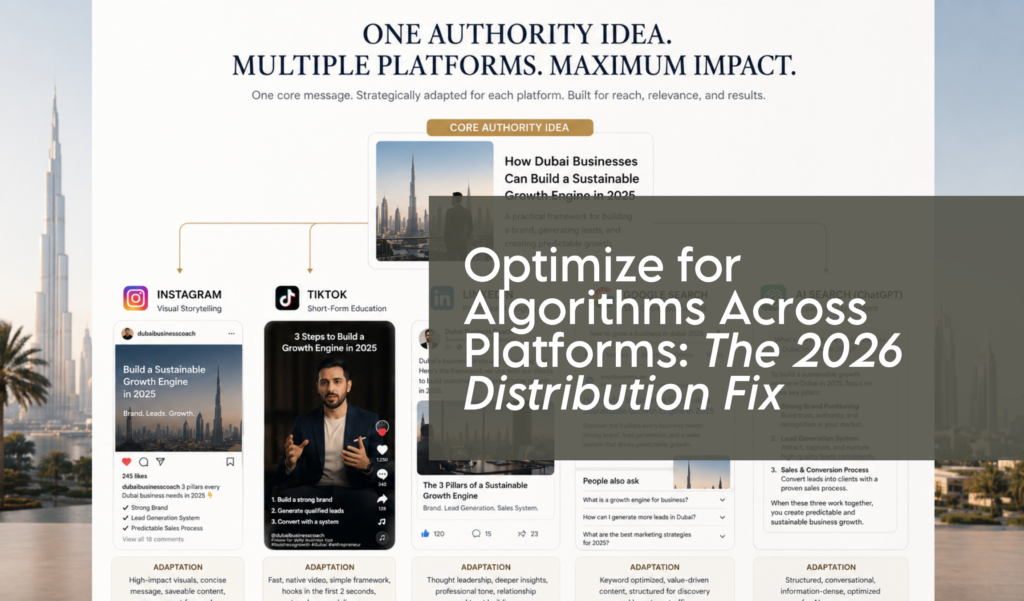
Multi-platform content distribution is the 2026 fix for brands that want to optimize one strong idea across Instagram, TikTok, LinkedIn, Google, and AI search without posting blindly everywhere.
Most businesses are not struggling because they lack content.
They are struggling because distribution has become fragmented.
In 2026, publishing the same content across every platform no longer produces consistent visibility. Algorithms now evaluate context, intent, interaction quality, and user behavior differently on each channel.
Because of that, distribution strategy matters more than posting frequency.
Instagram prioritizes watch time, saves, and share behavior. TikTok rewards retention and conversational engagement. LinkedIn values dwell time and thoughtful interaction. Google and AI search systems focus on structure, relevance, page experience, and entity clarity.
As a result, the same piece of content behaves differently everywhere.
This changes how brands should approach content creation entirely.
The goal is no longer to produce separate ideas for every platform. Instead, the goal is to build one strong authority idea and distribute it intelligently across multiple algorithms.
That distinction becomes critical for Dubai businesses.
Competition is already intense across hospitality, beauty, real estate, consulting, wellness, and lifestyle sectors. Under these conditions, random posting creates noise rather than authority.
Meanwhile, businesses with stronger distribution systems compound visibility over time.
They understand how to adapt one core idea into different formats that match the behavioral signals each platform rewards.
This is the 2026 distribution fix.
Not more posting.
Smarter distribution.
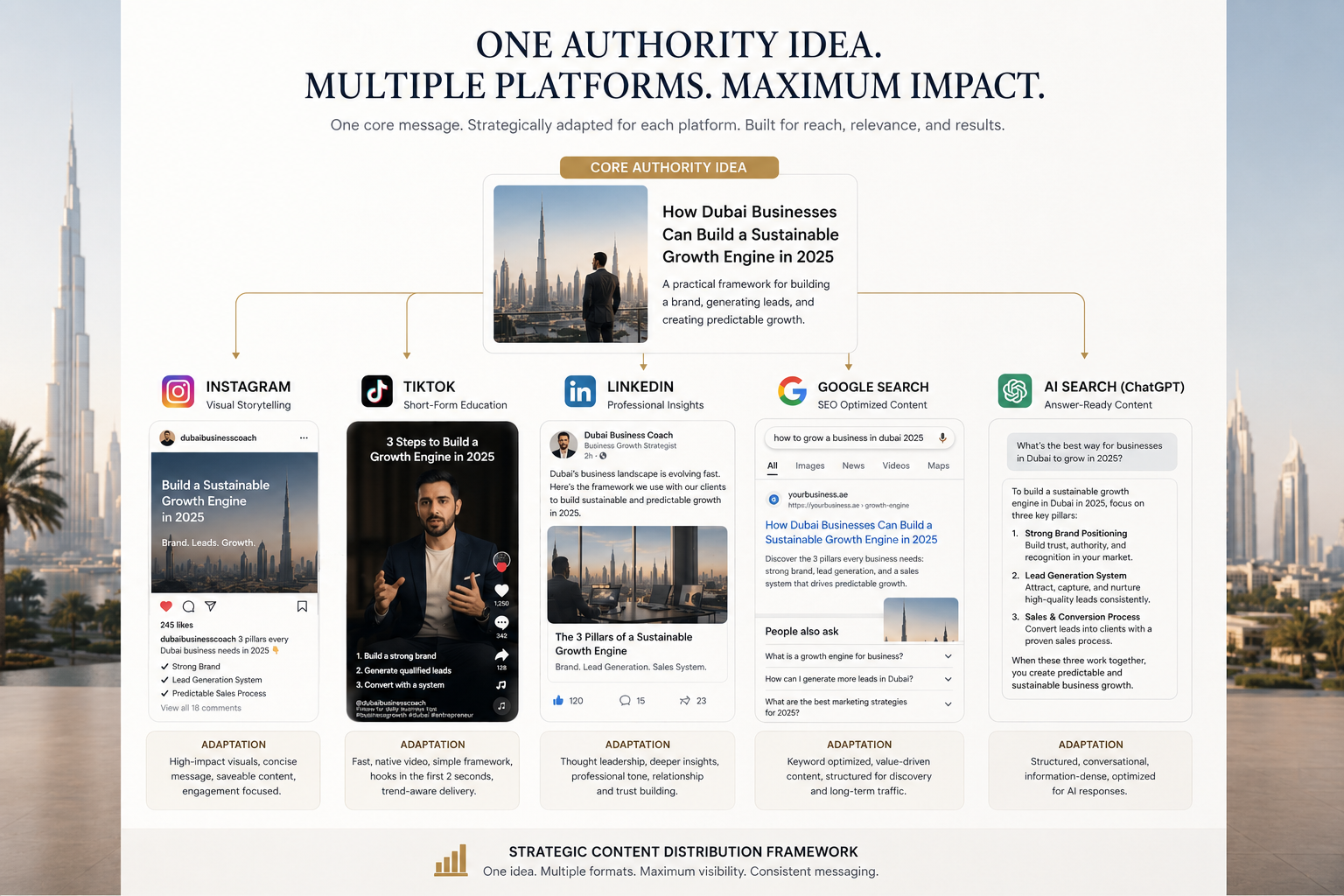
Start With One Strong Authority Idea
Most content systems fail because they begin with formats instead of ideas.
Businesses ask what Reel to post, what trend to follow, or what platform to prioritize before defining the actual authority topic behind the content.
As a result, distribution becomes reactive.
Strong distribution systems work differently.
They begin with one high-value topic connected to customer intent, business positioning, and long-term discoverability.
For example:
- How to choose a bridal salon in Dubai Marina
- What corporate clients expect from private dining restaurants in DIFC
- How luxury rental clients evaluate agents in Downtown Dubai
These topics solve real problems while reinforcing authority simultaneously.
More importantly, they create reusable distribution assets.
The original authority piece should live on the website first.
This matters because long-form content provides structure, depth, internal linking opportunities, FAQ sections, and search visibility. It also creates stronger contextual signals for AI search systems and Google AI Overviews.
Instead of producing isolated social posts, businesses build a central authority asset first.
Then distribution expands outward from that source.
This structure creates several advantages:
- consistent positioning
- stronger search visibility
- better AI discoverability
- content reuse across platforms
- longer content lifespan
Without this foundation, distribution becomes disconnected.
Posts may generate temporary engagement, yet they rarely reinforce a recognizable authority position over time.
Each Platform Rewards Different Behavioral Signals
The biggest mistake businesses make is treating algorithms as identical systems.
They are not.
Each platform evaluates different forms of engagement and user behavior. Because of that, content needs adaptation rather than duplication.
Instagram Prioritizes Retention and Saves
Instagram increasingly rewards content that keeps users engaged longer and encourages meaningful interaction afterward.
Watch time, saves, shares, and comments now matter far more than surface-level reach alone.
This changes how authority content should appear on the platform.
A long-form article about bridal salons in Dubai, for example, may become:
- a Reel explaining three mistakes brides make before booking
- a carousel summarizing key decision points
- a story sequence answering FAQs
The core idea remains identical.
However, the format adapts to Instagram’s engagement signals.
TikTok Prioritizes Hooks and Conversational Flow
TikTok operates differently.
The platform rewards strong opening hooks, content retention, and ongoing interaction within comment threads.
Because of that, authority content often performs better when it feels more conversational and less polished.
A restaurant discussing corporate dining in Dubai may use:
- story-driven customer scenarios
- behind-the-scenes operational insights
- myth-busting style videos
Rather than repeating Instagram formats directly, the business adapts the same authority idea into TikTok-native behavior patterns.
LinkedIn Prioritizes Dwell Time and Thoughtful Engagement
LinkedIn rewards depth differently.
The platform favors content that keeps users reading, generates professional discussion, and encourages profile exploration afterward.
This means authority content should focus on insight rather than entertainment.
A Dubai real estate agency discussing luxury rental behavior may publish:
- market observations
- client behavior analysis
- decision-making frameworks
- industry misconceptions
Native documents, long-form posts, and opinion-driven commentary often outperform trend-focused formats because they increase dwell time and meaningful engagement.
Google and AI Search Prioritize Structure and Intent
Search and AI systems evaluate content differently from social platforms.
Google and AI Overviews prioritize:
- clear structure
- intent alignment
- entity signals
- page experience
- contextual authority
Because of that, the original authority article becomes essential.
Strong headings, FAQ sections, fast-loading pages, internal links, and clear semantic structure all improve discoverability across search and AI-generated recommendations.
In 2026, distribution increasingly connects social visibility and search visibility into one ecosystem.
Why Distribution Systems Outperform Random Posting
Most businesses still approach content reactively.
A post gets published because the calendar requires activity. A trend gets replicated because competitors are using it. Platforms are treated separately instead of functioning as part of one connected distribution system.
As a result, visibility becomes inconsistent.
Strong distribution strategies operate differently.
Instead of producing endless disconnected content, they maximize the lifespan and reach of one strong authority idea across multiple environments.
This creates efficiency.
A single well-developed topic can support:
- website authority
- Instagram carousels
- LinkedIn thought leadership
- TikTok storytelling
- email sequences
- Google search visibility
- AI-generated discovery
At the same time, every platform reinforces the same positioning repeatedly.
This repetition strengthens recognition.
Customers begin associating the business with specific expertise rather than random content categories. Over time, authority compounds because the messaging remains connected across every channel.
Distribution systems also reduce creative burnout.
Businesses no longer need to invent entirely new ideas daily. Instead, they focus on extracting multiple high-quality executions from fewer but stronger authority topics.
This creates higher consistency without sacrificing depth.
The Shift From Volume to Signal Quality
Algorithms increasingly prioritize interaction quality over publishing volume.
Platforms now evaluate whether users:
- watch content fully
- save it for later
- share it privately
- spend time engaging
- return to the creator repeatedly
Because of that, low-context posting loses effectiveness quickly.
Meanwhile, highly relevant content generates stronger algorithmic signals even at lower publishing frequency.
This is especially important for Dubai businesses.
Audiences are exposed to extremely high content volume every day across hospitality, beauty, luxury, real estate, and service industries. Under these conditions, attention becomes selective.
People engage with content that feels immediately relevant to their situation, intent, or problem.
As a result, signal quality matters more than content quantity.
The businesses performing best across algorithms are often the ones producing fewer but more contextually aligned pieces.
Why Technical Experience Now Influences Distribution
Algorithms no longer evaluate content alone.
They increasingly evaluate the surrounding experience as well.
Social platforms monitor interaction quality, while search and AI systems assess technical performance signals such as:
- mobile usability
- Core Web Vitals
- page speed
- site structure
- content formatting
- user engagement behavior
This creates a major shift.
Distribution is no longer isolated from UX and technical SEO.
For example, a strong LinkedIn post may successfully drive traffic to a website. However, if the landing page loads slowly, feels cluttered, or lacks clear structure, user behavior signals weaken immediately.
As a result, performance declines across both search and social ecosystems.
AI systems also depend heavily on structure.
Pages with clear headings, semantic organization, FAQ sections, and contextual clarity are easier for AI models to interpret and surface inside generated answers.
Because of that, technical optimization now supports distribution directly.
The content itself may attract attention initially.
However, the surrounding experience determines whether algorithms continue amplifying it.
Measure Distribution Signals, Not Vanity Metrics
Most businesses still evaluate content performance incorrectly.
Follower growth and impressions may create visibility, yet they rarely explain whether distribution is actually working commercially.
Modern distribution strategies require deeper signal analysis.
On Instagram and TikTok, strong indicators include:
- watch time
- completion rate
- saves
- shares
- meaningful comments
On LinkedIn, businesses should monitor:
- dwell time
- quality of discussion
- profile visits
- website clicks
- decision-maker engagement
For Google and AI search, stronger indicators include:
- search impressions
- click-through rates
- AI Overview visibility
- time on page
- internal navigation behavior
These metrics reveal whether the authority idea actually aligns with audience intent.
More importantly, they help businesses identify which content deserves deeper distribution investment.
Instead of posting endlessly, businesses can amplify the authority topics already generating the strongest behavioral signals.
This creates smarter allocation decisions over time.
How MG Lumeo Approaches Multi-Platform Distribution in 2026
Most businesses still separate platforms too aggressively.
Instagram becomes one strategy. LinkedIn becomes another. SEO operates independently. TikTok follows trends disconnected from the broader positioning.
As a result, visibility fragments.
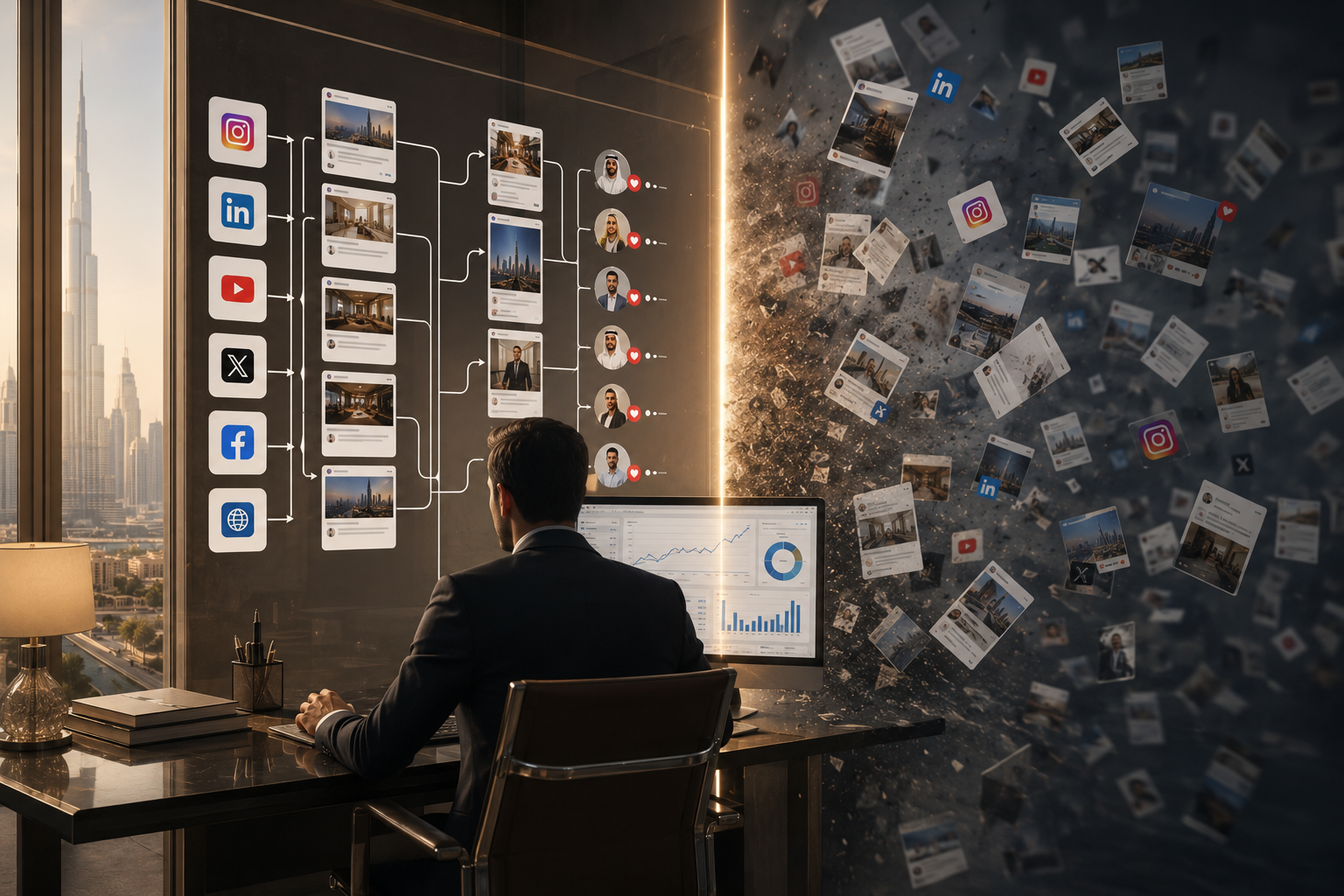
At MG Lumeo, distribution is approached as one connected ecosystem.
The process starts with identifying authority ideas that align with business positioning, customer intent, and long-term discoverability. Instead of producing isolated content pieces constantly, the focus shifts toward building high-value topics that can evolve across multiple environments.
This creates stronger consistency.
Every platform reinforces the same expertise from a different angle. Instagram supports visibility and engagement. LinkedIn reinforces authority and professional relevance. Google and AI search strengthen discoverability and long-term traffic. TikTok expands conversational reach and attention velocity.
However, the core positioning remains stable throughout the system.
This matters because algorithms increasingly reward contextual consistency.
When businesses repeatedly demonstrate expertise around the same themes, platforms begin associating them with clearer authority signals. Over time, this improves both distribution efficiency and discoverability.
Another important factor involves platform adaptation.
The goal is not reposting identical content everywhere. Instead, each execution is shaped around the dominant behavioral signals of that specific environment.
For example:
- Instagram content focuses on retention, saves, and shareability
- LinkedIn prioritizes insight, discussion quality, and dwell time
- TikTok emphasizes conversational hooks and engagement velocity
- Google and AI search prioritize semantic structure, intent, and UX clarity
Because of that, one authority topic can generate multiple algorithm-friendly executions without losing strategic alignment.
This also improves operational efficiency.
Businesses stop chasing endless trends and begin building reusable distribution frameworks. Content gains a longer lifespan because each authority idea continues generating visibility across different channels over time.
For Dubai businesses, this creates a major advantage.
The market already moves at high speed, and attention shifts constantly. Brands relying only on reactive posting often struggle to maintain stable recognition. Meanwhile, businesses with structured distribution systems compound authority steadily across multiple discovery environments.
That consistency becomes increasingly valuable as AI-driven discovery expands further.
Why Distribution Is Becoming More Important Than Content Volume
Content volume alone no longer guarantees visibility.
Algorithms increasingly prioritize relevance, contextual fit, interaction quality, and user behavior patterns. Because of that, weaker distribution strategies often underperform even when content production remains high.
Meanwhile, businesses distributing fewer but stronger authority ideas often generate better long-term results.
This reflects a broader shift happening across digital marketing.
The advantage no longer belongs to the businesses publishing the most.
The advantage belongs to the businesses distributing strategically.
That shift changes how marketing should be structured moving forward.
Instead of asking:
- What should we post today?
The stronger question becomes:
- How do we distribute one valuable idea across every environment where our audience already searches, scrolls, and decides?
That question leads to stronger systems.
Final Perspective
The 2026 distribution fix is not about learning algorithm hacks.
It is about understanding how different platforms interpret value differently.
Instagram rewards retention and saves. TikTok prioritizes hooks and engagement flow. LinkedIn values insight and professional interaction. Google and AI systems focus on structure, relevance, and contextual authority.
Because of that, distribution now requires adaptation rather than duplication.
Businesses that continue posting identical content everywhere often struggle to maintain visibility consistently. Meanwhile, businesses that build authority-driven distribution systems create stronger long-term discoverability across multiple ecosystems.
The strongest strategies start with one valuable idea.
Then they distribute that idea intelligently based on how each algorithm evaluates user behavior.
In Dubai’s highly competitive environment, this distinction matters even more.
Attention is fragmented, competition is intense, and discoverability increasingly depends on contextual relevance rather than publishing volume alone.
The goal is no longer to post everywhere.
The goal is to distribute strategically enough that every platform reinforces the same authority position over time.


Social Profiles