What a Press Release Is in 2026 — and Why AI Search Changed What It's For
On this page
- The short answer
- What a press release is
- The release, the coverage and the AI answer are three different things
- What AI search changed
- What a press release is for in 2026
- Earn coverage that others will cite
- Put the official facts on the record
- Give AI something it can quote
- What a press release is not
- Not an ad
- Not a way to buy links
- Not a guarantee
- When a press release is the right tool
- Are press releases worth it?
- What is a press release in SEO?
- What does PR stand for?
- What does ### mean at the end of a press release?
- What are the disadvantages of using a press release?
- Does it cost money to do a press release?
A press release still does one job: it gives journalists an official announcement they can check and, if they think it’s worth it, turn into a story. What has changed is who reads that story. ChatGPT, Gemini and Google AI Overviews now pull their answers from news coverage, so an article a reporter writes about you can end up shaping what AI tools tell people about your business.
A press release is still written for journalists: an official announcement they can check and turn into a story if they think it deserves one. What changed is who reads what those journalists publish, because ChatGPT, Gemini and Google AI Overviews now answer questions from coverage like theirs.
So if you have news coming up, or someone has pitched you a press release package, it is fair to ask what one is for now. This guide explains what a press release is in 2026, what AI search changed about its use, what it is not, and when to send one. The short answer comes first.
The short answer
A press release is an official statement a company sends to journalists to announce something new that they may choose to report. In 2026 the coverage a release earns matters more, because AI answers cite sources brands do not own or pay for far more often than they cite ads.
The release is yours. The coverage it earns is someone else's, and AI answers mostly cite sources like that: ones brands do not own or pay for.
Muck Rack's October 2026 study found more than 84% of AI citations came from earned media and other third-party sources. Paid and advertorial content was 0.3%.
A release is not an ad, and it is not a way to buy links. Google asks for paid links to be marked as sponsored.
Send one when you have real news a journalist would want. Skip it when you do not.
What follows is the full definition, part by part, and then the evidence for each line above.
What a press release is
A press release, also called a media release or news release, is an official statement a company or organisation gives to journalists, who can publish it, report on it or ignore it. Cambridge Dictionary puts that last part plainly: a statement given to journalists "to publish if they want to".
The press release meaning in marketing and business communication is the same. It is the company's official version of a piece of news, and one tool of public relations (PR). Wikipedia credits Ivy Lee, known as the father of modern public relations, with the first press release in October 1906, about a Pennsylvania Railroad accident.
Most releases follow the same order:
Headline
Dateline, with the city and the date
Lead paragraph, covering who, what, where, when and why
Body with the facts and figures
A quote from a named person
Boilerplate
Media contact
Boilerplate is the short "about" paragraph that ends every release, giving background on the company that issued it. Writing each part well has its own rules on length and timing.
The part most people miss comes after you press send: the release and the coverage it earns are not the same thing.
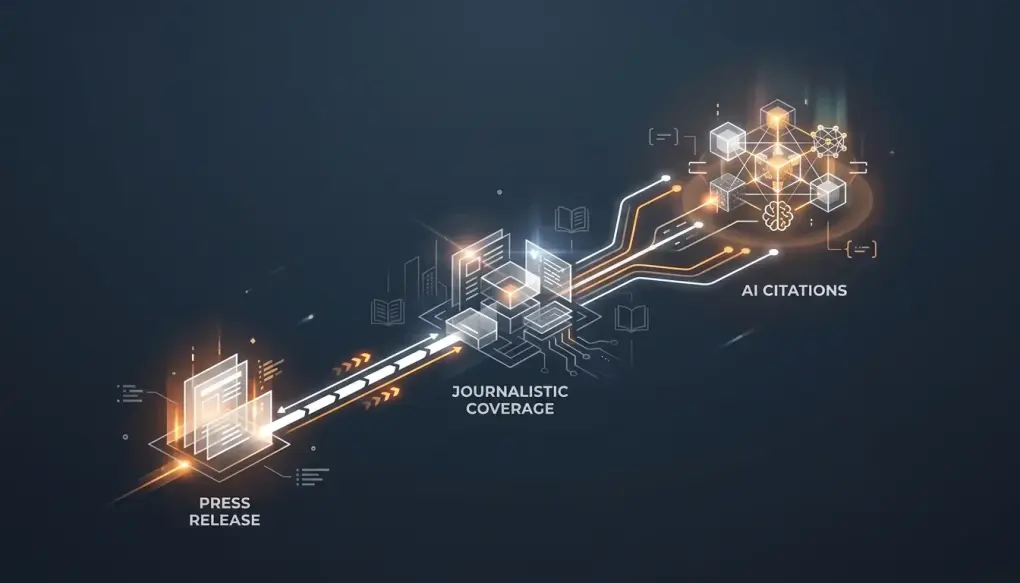
The release, the coverage and the AI answer are three different things
A press release on its own is not earned media. It is owned media when it sits on your website and paid distribution when you pay a wire service to carry it, and it becomes earned media only when a journalist or another site chooses to write about it.
Press release distribution means sending the release to journalists and to wire and syndication sites. It gets the release seen. It does not decide whether anyone writes about it.
What it is | Who controls it | Media type |
|---|---|---|
The release on your website | You | Owned |
The release carried by a paid wire service | You pay for it | Paid distribution |
A story a journalist writes from it | The journalist and the editor | Earned |
Muck Rack defines earned and third-party sources as those "brands don't own or pay for" (28 October 2026).
AI answers mostly cite the third row and other third-party sources. The release is how you start, the coverage is what gets read, and the numbers on what AI answers cite show how wide that gap is.
What AI search changed
AI answers cite their sources, and most of those sources are ones brands do not own or pay for. Muck Rack's October 2026 What Is AI Reading? study, which looked at ChatGPT, Claude, Gemini and Perplexity, found that:
more than 84% of citations came from earned media and other third-party sources, such as journalism, encyclopedic sites, government and NGO sites, academic research and third-party company content
journalism alone was 22% in September, down from 27% in May
brands' own sites were 15.2%
paid and advertorial content was 0.3%
The October edition does not single out press releases, but earlier editions did. Muck Rack's December 2025 study found press-release citations grew "5x since July 2025", and its May 2026 study found releases appear "almost exclusively in industry trend responses", at 3.5 times the rate they appear in best-of answers. So a press release can be the source when people ask what is changing in an industry, and it turns up far less when they ask which brand to buy.
For Google AI Overviews and AI Mode, the source to read is Google itself. Its guide to generative AI features says they "are rooted in our core Search ranking and quality systems", and that site owners can ignore tactics like "pursuing inauthentic mentions". Its spam policy also lists "attempting to manipulate generative AI responses in Google Search" as spam.
How each AI engine picks its sources is a bigger question than this guide covers.
Two limits apply to the Muck Rack figures. Muck Rack sells AI-visibility tracking, and its full method sits behind a download form. The answers it measured also change from run to run: when the same prompt ran twice in one day, ChatGPT repeated only 41% of the cited domains. Read the shares as a direction rather than a promise, and that direction says something clear about what a press release is for now.
What a press release is for in 2026
The purpose of a press release is still to give journalists a story they can check and report. In 2026 that coverage, along with the facts on your own site, also feeds the answers AI systems give.
What a press release is used for has not changed. Who reads the result has. For example, a new product line, a funding round or a first store in a new market can each become a story, and that story can now end up inside AI answers as well as in print or online.
Earn coverage that others will cite
The first job is unchanged. Journalism made up 22% of AI citations in September in Muck Rack's October 2026 study, and a journalist's story is the kind of earned media AI answers lean on. Your release is how that story starts. In Google Search too, the value comes from the coverage, not from the release itself.
Put the official facts on the record
A release on your own site is the dated, first-party version of the news, with the names, dates and figures in one place and a quote from a named person. In the same Muck Rack study, brands' own sites made up 15.2% of AI citations, and product pages and guides were "often cited" for product and how-to questions. Keep the release accurate, because it is what others will check their story against.
Give AI something it can quote
Muck Rack's December 2025 study found the press releases AI cited carried "2x as many statistics" on average and a "30% higher rate of objective sentences". Plain facts and figures travel. Adjectives do not. Writing a release that way takes practice of its own.
Knowing what a release is for also makes it easier to see what a press release is not.
What a press release is not
A press release is not an advertisement, a link scheme or a promise of coverage, and treating it as any of those is where the money gets wasted.
Not an ad
An ad is space you buy. A release is news a journalist may or may not use, even if both come out of the same marketing budget. In Muck Rack's October 2026 study, paid and advertorial content made up 0.3% of AI citations, and ChatGPT cited Forbes' editorial articles about 1.7 times as often as its pay-to-play Forbes Councils content. Where a release ends and advertising begins is worth knowing before you pay for either.
Not a way to buy links
Google's spam policy lists "Exchanging money for links, or posts that contain links" as link spam when it is done for ranking. Its page on outbound links asks for links that are "advertisements or paid placements" to be marked rel="sponsored". Google does not treat wire services themselves as a problem: its site reputation policy lists "Wire service or press release service sites" as not inconsistent with that policy. The point is narrower. A paid release is not an SEO tactic.
Not a guarantee
Distribution puts a release in front of journalists, and they decide whether to write about it. Muck Rack also notes that "a strong result in one model does not guarantee the same visibility in another". Anyone promising placements or AI mentions from a release alone is promising something nobody controls.
So the useful question is when a press release is the right tool.
When a press release is the right tool
A press release is worth sending when you have news a journalist outside your company would want to report, and it wastes money when the only audience is yourself. For an e-commerce brand, that one question sorts most announcements. Here is what passes it, for example:
a new product line or category
entering a new market, or opening your first physical store
a funding round, merger or partnership
a senior appointment
original research or data from your own business that says something about the market
That last one matters more now, because Muck Rack's May 2026 study found press releases are cited mostly on industry-trend questions.
And what does not:
a website redesign that changes nothing for customers
a routine sale or discount, which is an ad
news you cannot back with a named person, a date and a figure
If you need journalists to attend something, such as a launch event, a media advisory may fit better than a release.
Whether a press release is worth the effort at all is the first question below.
Are press releases worth it?
A press release is worth it when it carries news a journalist would report, because coverage is one of the earned sources AI answers lean on, while paid content is rarely cited. It is not worth it as a substitute for news, or as a way to buy links or AI mentions. Search Engine Land's guide of 1 October 2026 puts it this way: "Press releases still work. But only if you give journalists a reason to care." The same condition decides what a press release does for SEO.
What is a press release in SEO?
In search engine optimization (SEO), a press release is not a link-building tool. Its value comes from the coverage and mentions it earns, not from the links inside it. Google asks for paid placements to carry rel="sponsored", and lists paying for "posts that contain links" for ranking as link spam. A story a journalist writes from your release is a normal editorial source for Google Search, and the same kind of source AI answers cite. That is also why a release is one part of PR, not the whole of it.
What does PR stand for?
PR stands for public relations, the work of managing how an organisation is seen, and a press release is one tool of PR. Some people also write "PR" for a press release itself; AdLift's guide describes a press release as "often referred to simply as PR". Most people mean the discipline, but not everyone does, so check which one is meant. The symbols at the end of a release cause the same kind of confusion.
What does ### mean at the end of a press release?
### marks the end of a press release. It tells the journalist nothing more follows, and the older mark for the same job is -30-. Wikipedia notes that, in a press release, -30- traditionally sat after the boilerplate or body and before the media contact, and that ### is "a more modern equivalent". Marks like these are easy to learn; the disadvantages of a press release take more thought.
What are the disadvantages of using a press release?
The main disadvantage of a press release is that you control what you send, not what gets written. A journalist may ignore it, or report it from their own angle. Paid distribution can put your text on many sites without anyone choosing to cover it, and those copies are not earned media. AI answers also shift between runs: in Muck Rack's October 2026 study, ChatGPT repeated only 41% of cited domains when the same prompt ran twice in a day, so one AI answer is not a measure of success. Then there is what it costs.
Does it cost money to do a press release?
Writing a press release and posting it on your own site costs nothing but time. What costs money is paid distribution through a wire service, plus writing or outreach if you hire someone to do it. One US wire service, eReleases, lists national distribution from $399 (checked 3 November 2026). A higher distribution price buys reach, not coverage. The sources for every figure, and who wrote this guide, come next.
Send us an enquiry