Press Release Templates and Generators: What They Get Right, and the Part They Can't Do
On this page
- The short answer
- What press release templates and generators get right
- The format a template gets right
- The press kit around the release
- Templates, generators and chatbots side by side
- The part no template or generator can do
- A reason to care
- The right journalist
- How to use a template or generator without sounding generic
- When a tool is enough, and when to bring in help
- FAQ Can AI write a press release?
- FAQ What are the main parts of a press release?
- FAQ How do I end a press release?
- FAQ How much does it cost to write a press release?
- FAQ Is a free press release template good enough?
A press release template gets the format right: headline, dateline, lead, quote, boilerplate, contact. An AI generator goes a step further and turns your notes into a first draft in minutes. Neither can give a journalist a reason to care, and that’s what decides whether your release gets run.
A template gives you the shape of a press release. It can't give you the one thing that gets it run: a reason to care.
Press release templates and AI generators are good at the format (headline, dateline, lead, quote, boilerplate, contact), and an AI generator can turn your notes into a first draft in minutes. This guide shows what each kind of tool gets right, the part none of them can do, and how to use one without sounding like everyone else who used it. It starts with the short answer.
The short answer
A press release template or an AI generator can give you a correctly formatted release and a first draft. It cannot tell you whether your announcement is news, or get it in front of the journalist who covers your area.
Use the tool for the format and the first draft. Bring the news angle, the facts and the contacts yourself.
A free template in Word, Google Docs or PDF is enough for the format.
An AI generator or a chatbot is useful for a first draft, as long as you give it real facts.
Neither can judge whether an editor will care. In Muck Rack's 2026 survey of journalists, mostly in the US, 88% said they immediately disregard pitches that miss their beat.
Check every fact before you send it. Google gives the same advice for anything written with AI: "manually factcheck and review all AI-generated content for accuracy and trustworthiness before publishing."
The detail starts with what these tools do well.
What press release templates and generators get right
Press release templates and generators do three jobs well: they fix the format, they speed up the first draft, and they remind you which parts a journalist expects.
Templates fix the format. Press Ranger, a wire service, says "Editors, wire services, and AI assistants all consume the same format". Because the format is shared, a press release template barely changes from one announcement to the next, and starting from one saves you rebuilding the layout each time.
Generators speed up the first draft. Presscloud, which sells a press release generator, says its AI generator "writes a ready-to-use press release within 1 minute", using "the information you fill in, plus your website, social media and previous articles". That speed figure is Presscloud's own claim.
Event-type templates work as a checklist. PR.co's product launch template asks why the product is valuable, which problem it solves, who it affects and why it is newsworthy. Its event template asks for the date, time, venue and ticket details.
Each tool gives real help with the writing, and that help covers the easy half of the job. The clearest example is the format a template gets right.
The format a template gets right
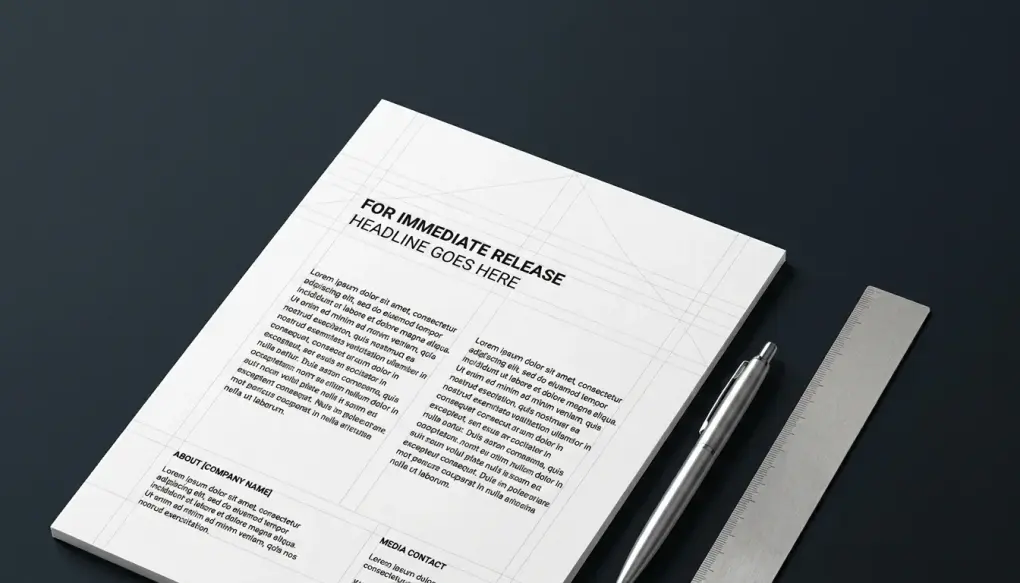
A press release template lays out the same parts in the same order, so a journalist can find the news, the quote and the contact without hunting. Most templates follow the order in Press Ranger's skeleton:
A "For immediate release" line, or an embargo date if the news must wait.
Headline. Press Ranger's rule is "specific, active, contains the news, under 100 characters". This is the line a headline or title generator drafts for you.
Subheadline: one supporting detail.
Dateline and lead: the city, the date, and the news in the first sentence. For a UAE release the dateline is the city, for example Dubai. US templates show "[CITY, State]", a form that does not fit a release from the UAE.
Body: background first, then detail.
Quote. Press Ranger asks for "a quote a person would say out loud: why this matters or what it makes possible, not a repeat of the lead".
Boilerplate: a short "About" paragraph of one to three sentences on the company, "identical to the description used everywhere else", ending with the website address.
Media contact.
"###" on its own line to mark the end.
Press Ranger puts the whole release "at around 400 words".
Templates come as Word files, Google Docs, PDFs and Canva designs, and most galleries on the first page of Google offer them free. Many are sorted by announcement type. PR.co's set includes a product launch press release template, a grand opening, new hires, and an investment or funding round.
A sample press release template or an example release shows the parts filled in. It does not show why the news worked, and the same limit applies to the other thing people search for alongside a template: the press kit.
The press kit around the release
A press kit is the set of files a journalist needs to cover your company without asking you for them: company background, images, recent press releases, past coverage and a contact. Press-kit guides on the first page of Google list much the same contents:
an introduction and company bio
high-resolution images and logos
recent press releases
past media coverage
founder or spokesperson details, and a media contact
One item on that list has survey backing. In Muck Rack's 2026 survey of journalists, mostly in the US, "High-resolution images" were listed among the things that make a pitch valuable.
A press kit template or a set of press release kit examples gives you this checklist, and that is useful. It cannot fill the media coverage slot, because that slot only fills when journalists have written about you. For a young brand, leaving it out is better than padding it.
How a press kit differs from a press release is a separate question; this section only covers what goes in one. The bigger choice is which kind of tool to use, and how the tool types compare.
Templates, generators and chatbots side by side
Press release tools come in five types, and they differ in how much they write for you, not in whether they can make your news matter. The table describes two kinds of press release template, a press release generator, a general chatbot and a PR platform, each in its maker's words.
Tool type | What its makers say it does | What you still supply | Where it stops |
|---|---|---|---|
Blank template (Word, Google Docs, PDF, Canva) | Gives the standard layout. PR.co: "replace the text in [brackets] with your information". | Every word, the angle and the facts | Format only; no help with wording |
Event-type template (product launch, opening, funding) | Adds prompts for what that announcement needs (PR.co). | The facts and the angle | Reminds you what to include, but not why anyone should care |
AI press release generator | Drafts a full release from your inputs. Presscloud: "within 1 minute" from "the information you fill in". Embarque: "Simply input your key information". | Accurate facts, a real quote and the angle | Writes from what you give it; cannot judge whether it is news |
General chatbot with a prompt (ChatGPT, Claude) | Press Ranger, a wire service, publishes a prompt to paste "into ChatGPT, Claude, or the Press Ranger AI writer". | The same as an AI generator, plus checking the format | The same limit as a generator. Google says to "manually factcheck and review" AI-generated content before publishing |
PR platform (generator, journalist list and sending) | Presscloud says "AI builds your press list too" and sends the release from the platform. | Facts, the angle, and a check that the list covers your market | The list helps only where it covers your market; the examples on Presscloud's own page are Dutch outlets |
Headline and title generators do the AI generator's job for a single line. Whichever press release writing tool you choose, it works from what you give it.
Which to pick depends on the job:
If you know the angle and want the layout, a free template is enough.
If you have the facts and want a first draft fast, use a generator or a chatbot with a structured prompt, then edit the draft using the steps further down.
If you need the release in front of specific journalists, no tool will decide who they are.
That last point is the part no tool can do.
The part no template or generator can do
A template or generator cannot supply the two things that decide whether a release gets run: a reason for an editor to care, and a route to the journalist who covers your area. In Muck Rack's 2026 survey of journalists, mostly in the US, 88% said they immediately disregard pitches that miss their beat.
A reason to care
A tool writes from your inputs, so it cannot add news that is not there. Editors call this newsworthiness, and the template makers say so themselves. PR.co's product launch template asks why the launch is newsworthy, and its notes on product updates say "in order to land coverage, your news must be, well, newsworthy". Press Ranger lists three returns from a press release (coverage, search authority and AI visibility) and says "A release with no news earns none of the three".
Muck Rack's 2026 survey (897 responses, mostly from US journalists) lists what journalists value in a pitch, including "Clear relevance to their beat", "Access to relevant sources" and "Original research or data". Original data is the one item a generator can never invent honestly.
The right journalist
Beyond the 88% figure above, the same survey found that "Nearly half of journalists say they seldom receive pitches that match their coverage". A template has no idea who covers retail or e-commerce at a UAE outlet, and a generator does not know either. A PR platform's list helps only where its database covers your market. Knowing the beat, and being someone the journalist has heard from before, is work done outside the document.
Both gaps matter more now that AI answers pick sources. Press releases are still wanted: in Cision's 2025 State of the Media survey of more than 3,000 reporters worldwide, "72% of journalists still cite press releases as the most useful resource PR teams can offer". AI answers lean on the coverage a release earns, which is earned media, more than on the release alone. Muck Rack's May 2026 analysis of more than 25 million links cited by ChatGPT, Claude and Gemini found that "Earned media accounts for 84% of all AI citations" and "Paid and advertorial content represents just 0.3% of citations". A well-formatted release that no journalist picks up does little in either place.
The other side holds too. Muck Rack's December 2025 analysis found that, in AI citations, "Press releases grew 5x since July 2025", and the press releases that were cited carried twice as many statistics and 2.5 times as many bullet points on average. Format and facts do help once the news is real. The practical question is how to use a tool so the draft does not read like everyone else's.
How to use a template or generator without sounding generic
A press release from a template or generator sounds generic when the tool supplies the words and you supply nothing else. The fix is to give it more of what only you have, and to edit what comes back. This applies whether you start from a press release template or a press release generator.
Write the news in one sentence before you open any writing tool: what happened, to whom, and why a reader outside your company would care. If you cannot, no tool can.
Give the generator a brief, not a topic: the facts, the numbers you can stand behind, dates, prices if they are public, and who the news affects. Generators work from "the information you fill in", as Presscloud puts it.
Add one thing no other company has: your own data, a customer number you can verify, or a local detail. Journalists in Muck Rack's 2026 survey, mostly in the US, listed "Original research or data" as valuable.
Replace the generated quote with something a named person would say out loud. Generated quotes tend to praise; a real one explains.
Cut adjectives the tool added, such as "innovative", "leading" or "cutting-edge", unless a fact backs each one.
Check every fact, name and number before you send or post it. Google tells site owners to "manually factcheck and review all AI-generated content for accuracy and trustworthiness before publishing", and journalists in Cision's 2025 survey named "A lack of accuracy" as their biggest worry about AI in PR.
Accuracy is the line journalists draw. One journalist quoted by Cision put it this way: "I don't care if it's AI generated, I care if it's correct."
If you publish releases in a newsroom on your own site, Google also warns that "using generative AI tools or other similar tools to generate many pages without adding value for users may violate Google's spam policy on scaled content abuse". One real release beats ten generated ones. Keep the boilerplate the same everywhere it appears.
If those steps feel like more than you have time for, the next question is when it is worth bringing someone in.
When a tool is enough, and when to bring in help
A template or generator is enough when you already know the news angle and the journalists you will send it to. Help is worth paying for when either of those is missing.
A tool is enough when:
the news is clear and you can say it in one sentence
you already know who covers your area, and they know you
it is a routine update for your own newsroom page or for partners
Help is worth it when:
you are not sure the announcement is news, or what the angle is
you do not know which journalists cover your area, or you have no contact with them
the stakes are high, such as a launch tied to a campaign, or a company statement in a difficult moment (PR.co offers a separate template for a "Company statement/emergency announcement")
The writing of a press release can come from in-house communications or marketing staff, a PR agency or a freelance writer, and many releases are now drafted with AI tools. What matters is who supplies the angle and the contacts, more than who types the words.
The questions below are ones people search for about AI and templates.
FAQ Can AI write a press release?
Yes, AI can write a press release draft from the facts you give it. It cannot decide whether the announcement is news or who should receive it. Journalists are not against PR teams using AI as such: in Cision's 2025 survey of more than 3,000 reporters, only 27% said they were "strongly opposed", and their biggest worry was "A lack of accuracy". Use the AI tool for the draft, check every fact, make the angle your own, and make sure the release has the parts it needs.
FAQ What are the main parts of a press release?
There is no fixed number of parts in a press release, but most templates share the same core: headline, subheadline, dateline and lead, body, quote, About boilerplate and media contact, ending with ###. Press Ranger, a wire service, lists "Headline, subheadline, dateline and lead paragraph, one or two body paragraphs, a quote from a named person, an About boilerplate, and a media contact block, at around 400 words." The last two parts also tell you how a release ends.
FAQ How do I end a press release?
A press release ends with an About boilerplate and a media contact, followed by ### on its own line, which tells an editor the release is finished. Most templates already include all three, so check they are filled in and that the contact is a person who will answer. What all of this costs is the next question.
FAQ How much does it cost to write a press release?
Writing a press release can cost nothing with a free template or a chatbot, but the costs that matter are your time, any help with the angle, and distribution, which is priced separately. As one example of distribution pricing, Press Ranger, a US wire service, lists "wholesale prices" of $299 to $399 flat for publishing to named outlets (checked on 3 November 2026). Paid distribution places the text; it does not make a journalist write about it. That leaves the question of whether a free template is enough.
FAQ Is a free press release template good enough?
A free press release template is good enough for the format, because the parts and their order are the same in free and paid templates. Template galleries on the first page of Google offer free Word, Google Docs, PDF and Canva versions, and Press Ranger notes that editors, wire services and AI assistants "all consume the same format". What a paid tool adds is speed or a contact list, not a better layout. What decides whether the release runs is the news and the journalist you send it to. The section below sets out who wrote this guide and what it draws on.
Send us an enquiry