
Influencer marketing in Dubai is not slowing down. However, it is evolving.
In 2026, brands are shifting away from celebrity-scale creators and moving toward micro-influencers who drive measurable engagement and localized trust. While macro influencers still generate reach, micro creators consistently deliver stronger engagement rates and higher conversion efficiency at a fraction of the cost.
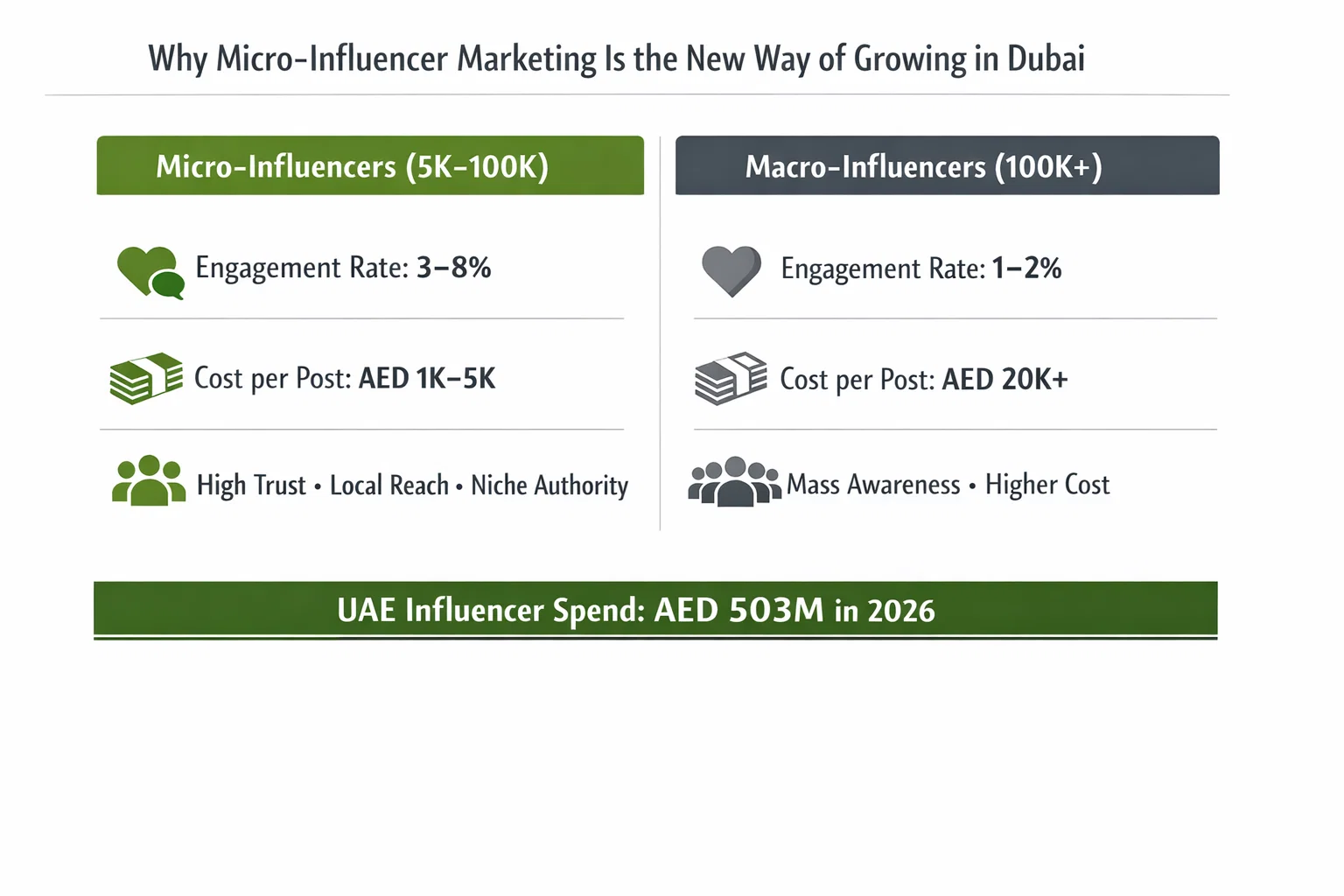
As UAE influencer spending continues to rise, reaching approximately AED 503 million across social channels, businesses are reevaluating where their budgets produce real return. Increasingly, the answer points toward micro-influencer marketing.
The shift is not based on trend cycles. It is driven by performance data.
The Structural Shift: From Reach to Relevance
Over the past decade, influencer marketing centered on follower counts. Brands pursued large audiences because visibility appeared proportional to scale.
However, audience behavior changed.
Consumers now scroll past overt advertisements. They question brand partnerships. They value relatability over celebrity status. As a result, engagement quality has overtaken audience size as the primary performance metric.
Micro-influencers, typically defined as creators with 5,000 to 100,000 followers, often achieve engagement rates between 3% and 8%. In contrast, macro influencers frequently average 1% to 2%.
Rolling Pixel’s 2026 analysis of micro-influencer strategies in the UAE highlights how smaller creators drive stronger audience interaction due to tighter community bonds:
https://rollingpixel.ae/micro-influencer-marketing-strategy/
Therefore, the advantage lies in connection rather than exposure.
Why Dubai Is a Unique Micro-Influencer Market
Dubai presents a highly distinctive digital environment.
First, the city is multicultural. Residents represent dozens of nationalities, each with distinct lifestyle preferences and purchasing behaviors. Micro-influencers often operate within specific cultural or community niches, which allows brands to target expat clusters effectively.
Second, Dubai is hyper-local despite its global image. Areas such as JBR, Downtown, Dubai Marina, and Business Bay function almost like micro-cities. A local fitness influencer in JBR can generate real foot traffic to a nearby gym within hours.
Enum Digital’s 2026 breakdown of micro-influencer impact for local businesses in Dubai explains how neighborhood-level trust drives higher conversion probability compared to broad awareness campaigns:
https://enumdigital.com/blog/micro-influencer-marketing-for-local-niche-businesses-in-dubai/
Moreover, Dubai consumers demonstrate selective trust patterns. High purchasing power does not automatically translate to impulsive behavior. Instead, recommendations that feel personal and authentic influence decisions more effectively.
Consequently, micro-influencers operate as peer validators rather than brand amplifiers.
Micro vs Macro: A Performance Comparison
Engagement and ROI differentiate micro from macro strategies.
| Aspect | Micro (5K–100K) | Macro (100K+) |
| Engagement Rate | 3–8% | 1–2% |
| Cost per Post | AED 1K–5K | AED 20K+ |
| Conversion Focus | High local intent | Broad awareness |
| Best Fit | Cafes, gyms, real estate niches | Luxury launches |
While macro influencers create visibility during major campaigns, micro-influencers excel in sustained community influence.
Conquerra Digital’s 2026 consumer behavior study emphasizes that audiences perceive micro partnerships as more trustworthy and less transactional:
https://conquerradigital.ae/how-influencers-are-changing-consumer-behavior-in-2026/
Therefore, engagement translates into conversion more consistently.
Ramadan, Expo 2030, and Cultural Timing
Dubai marketing does not operate on a Western calendar.
Ramadan, Eid, national holidays, and upcoming global events such as Expo 2030 influence purchasing patterns significantly. During Ramadan, for example, evening engagement increases. Lifestyle content, food reviews, and reflective messaging perform better than overt sales promotions.
Micro-influencers adapt quickly to these seasonal dynamics because they operate within active communities. They can modify tone, posting time, and messaging without large production delays.
Additionally, as Expo 2030 preparation accelerates, hospitality, tourism, and retail brands seek culturally nuanced visibility. Micro-creators embedded in local communities provide authenticity that traditional advertising often lacks.
Aark Marketing’s UAE influencer growth report outlines how localized partnerships increasingly outperform generic campaigns in the region:
https://aarkmarketing.com/blog/influencer-marketing-in-uae-from-creative-trends-to-strategic-growth-drivers/
Thus, cultural alignment strengthens ROI.
Real Performance Indicators: What Actually Matters
Follower count no longer determines campaign success.
Instead, brands should measure:
- Saves and shares
- Comment quality
- Story replies
- Link clicks
- Local inquiries
- Foot traffic
- Assisted conversions
For example, Noon.com reported measurable sales lifts from influencer-driven traffic during targeted campaigns, demonstrating how engagement can translate into revenue impact.
Similarly, Emirates Airlines leveraged influencer collaborations to increase booking visibility during promotional windows, reporting measurable uplift through multi-creator coordination.
Although macro influencers may generate higher impression counts, micro campaigns often deliver stronger cost-to-conversion ratios.
Therefore, performance metrics must shift from vanity statistics to commercial indicators.
The Cost Efficiency Factor
Budget allocation drives decision-making, particularly for SMEs.
A macro influencer charging AED 20,000 per post introduces substantial risk if engagement underperforms. In contrast, a micro-influencer campaign costing AED 2,000 to AED 5,000 allows brands to diversify partnerships across multiple creators.
This diversification reduces risk and increases testing capacity.
Brands can:
- Test five micro creators instead of one macro
- Compare engagement patterns
- Identify community overlap
- Scale high-performing partnerships
Consequently, micro-influencer marketing aligns well with performance-focused businesses.
Implementation Framework for Dubai Brands
Successful micro-influencer campaigns require structure.
Step 1: Identify Niche Alignment
Search hashtags such as #DubaiFoodie, #DubaiFitness, #DubaiRealEstate. However, analyze audience quality rather than surface popularity.
Step 2: Evaluate Engagement Authenticity
Review comment sections. Genuine interactions indicate real influence.
Step 3: Structure Performance Metrics
Define KPIs before launch. Track inquiries, saves, and conversion touchpoints.
Step 4: Combine With SEO and Paid Retargeting
Micro-influencer content can drive awareness. Paid retargeting can capture warm audiences. SEO can sustain long-term visibility.
Hybrid integration increases campaign lifespan.
Why 60% of UAE Brands Are Shifting Budget Allocation
Market data indicates that a majority of UAE brands are reallocating influencer budgets toward smaller creators.
The reasons include:
- Rising macro costs
- Engagement fatigue
- Demand for measurable ROI
- Saturation of celebrity endorsements
- Consumer preference for authenticity
Rolling Pixel’s February 2026 report further highlights how nano and micro creators dominate niche verticals such as food, fitness, and real estate in Dubai:
https://rollingpixel.ae/micro-influencer-marketing-strategy/
Therefore, the shift is not experimental. It is strategic.
Integrating Micro-Influencers Into a Broader Growth Strategy
Micro-influencer marketing should not operate independently.
It works best when integrated into:
- Content marketing
- Paid amplification
- Local SEO
- Email nurture sequences
For example, influencer-created content can be repurposed into website testimonials. It can also support Google Ads retargeting campaigns. Additionally, blog features can reinforce partnership credibility.
When structured correctly, micro-influencers become part of a digital ecosystem rather than isolated campaign assets.
How MG Lumeo Approaches Micro-Influencer Strategy in Dubai
At MG Lumeo Digital, micro-influencer campaigns are treated as performance channels rather than branding experiments.
The approach includes:
- Audience quality assessment
- Geo-specific targeting
- Cultural calendar planning
- Multi-creator testing frameworks
- Conversion tracking alignment
- Paid amplification layering
Rather than focusing on reach alone, the objective centers on measurable impact.
In Dubai’s competitive digital environment, authenticity paired with data produces sustainable growth.
Final Perspective
Influencer marketing in Dubai continues to expand. However, the structure of effective campaigns has changed.
Micro-influencers provide localized trust, measurable engagement, and cost efficiency. For SMEs and performance-focused brands, they offer a practical alternative to high-budget macro campaigns.
Nevertheless, success depends on structure, tracking, and integration.
Micro-influencer marketing is not a shortcut. It is a calibrated strategy.
When executed correctly, it becomes one of the most reliable growth channels in Dubai’s evolving digital ecosystem.






Social Profiles