Organic reach once felt like a reliable growth engine.
Publish consistently. Rank in search. Build an audience. Let traffic compound.
In 2026, the landscape looks different.
Algorithm shifts, AI-generated summaries, declining social reach, and content saturation have reshaped how organic visibility works. At the same time, organic traffic still drives approximately 53% of website visits on average across industries, reinforcing its long-term value.
The real question is no longer whether organic works.
The question is whether businesses can rely on organic reach and traffic alone in 2026.
The Case for Organic Reach
Organic growth remains powerful for structural reasons.
First, organic search traffic compounds. Once content ranks and authority builds, traffic continues without incremental ad spend. Unlike paid campaigns, there is no direct cost per click after initial optimization.
Second, organic traffic is intent-driven. Industry benchmarks consistently show that inbound leads convert at significantly higher rates than outbound efforts. In some studies, inbound strategies demonstrate close rates as high as 14.6% compared to 1.7% for traditional outbound approaches.
Third, organic visibility strengthens brand authority. When businesses consistently appear in search results, LinkedIn discussions, or industry blogs, credibility builds over time.
On social platforms, however, reach dynamics vary. LinkedIn personal profiles often achieve stronger organic distribution than company pages. Engagement-driven content still receives meaningful exposure when audience relationships exist.
Sprout Social’s 2026 organic reach analysis emphasizes that engagement quality, content structure, and posting cadence remain key drivers of organic performance, even as reach percentages fluctuate:
https://sproutsocial.com/insights/organic-reach/
For niche experts, consultants, B2B founders, and bootstrapped SaaS companies, organic remains a viable long-term growth strategy.
However, sustainability requires patience.
The Structural Limitations of Organic Reach in 2026
Organic reach is not disappearing. It is becoming structurally constrained.
The decline is not emotional. It is mathematical.
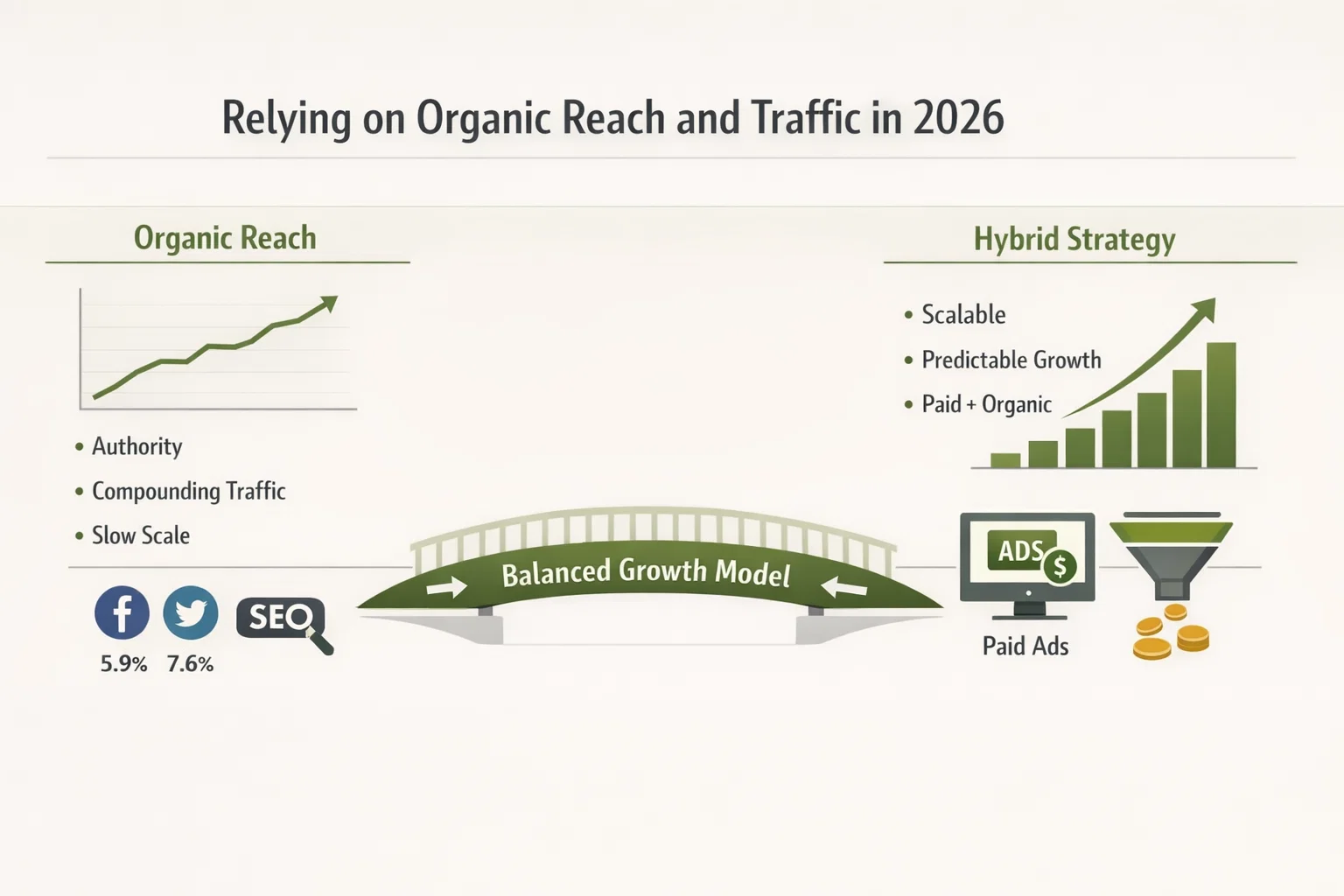
On social platforms, organic distribution is algorithmically filtered. Facebook brand pages average around 5.9% reach. Instagram business accounts average approximately 7.6%. These figures fluctuate, yet the pattern remains consistent: platforms prioritize paid promotion and engagement-heavy content over neutral brand publishing.
Addictive Digital’s analysis of organic reach decline illustrates how platform saturation and algorithm refinements compress exposure across industries:
https://addictivedigital.co.uk/the-decline-of-organic-reach-on-social-media/
However, social reach decline represents only one layer of limitation.
Search behavior is also evolving.
AI-generated summaries, zero-click results, and conversational search interfaces increasingly deliver answers without requiring website visits. When Google AI Overviews present condensed responses, click-through rates decline, even if rankings remain stable.
Therefore, ranking does not guarantee traffic.
Furthermore, organic performance depends heavily on competitive density. In markets like Dubai, where real estate, fintech, hospitality, and corporate services sectors are digitally aggressive, organic visibility faces compounded saturation.
Every company publishes blog content. Every brand invests in SEO. Every founder posts on LinkedIn.
As a result:
- Publishing volume increases
- Content lifespan shortens
- Authority thresholds rise
- Ranking timelines extend
Another structural limitation involves unpredictability.
Algorithm updates can reduce impressions overnight. A single LinkedIn visibility adjustment or Google core update may shift traffic distribution significantly.
Businesses relying exclusively on organic reach expose themselves to external platform volatility.
In addition, organic scaling requires time.
SEO authority development can take six to twelve months before compounding effects stabilize. Social media audience growth requires consistent engagement cycles. For businesses with immediate revenue requirements, this timeline introduces financial pressure.
It also requires consistent content velocity. Maintaining blog production, social posting cadence, and optimization cycles demands internal resources.
When resource allocation weakens, organic performance often declines.
Therefore, organic reach is powerful, but fragile without complementary systems.
It rewards patience. It punishes dependency.
Who Organic Still Works For in 2026
Remains effective under certain structural conditions.
Bootstrapped SaaS Companies
For early-stage SaaS startups with limited capital, organic SEO and thought leadership can establish authority gradually. Educational blog content, case studies, and niche tutorials compound over time.
Consultants and Industry Experts
LinkedIn thought leadership, newsletter growth, and long-form blog content remain powerful authority drivers for consultants and B2B professionals.
Local Service Businesses
Search-driven local services benefit from “near me” queries. For example, Dubai-based real estate firms targeting location-specific phrases such as “apartments for sale Dubai Marina” can generate qualified organic traffic.
Long-Term Brand Builders
Companies focused on sustainable authority rather than short-term revenue spikes can rely more heavily on organic strategies.
Works best when:
- Time horizon exceeds 12 months
- Competition is niche rather than saturated
- Authority positioning is clear
- Patience exists for compounding results
Who Should Not Rely Solely on Organic
Certain business models require scale and speed.
E-commerce in Competitive Markets
Dubai-based eCommerce brands operating in fashion, electronics, or beauty face intense competition, organic traffic growth may take months, while inventory turnover requires immediate sales velocity.
New Product Launches
Launching a new product without paid amplification often results in limited initial exposure, and organic channels rarely generate sufficient awareness alone during launch phases.
High-Competition Sectors
Real estate, fintech, hospitality, and corporate services in Dubai operate within dense digital ecosystems, organic reach may support authority but cannot guarantee rapid acquisition.
Revenue-Driven Growth Teams
Businesses accountable to aggressive quarterly targets often require hybrid acquisition strategies to stabilize revenue forecasting.
In these contexts, relying exclusively on organic reach introduces financial volatility.
The Dubai Context: Organic in a Competitive Market
Dubai presents unique digital conditions.
The market is:
- Multilingual
- Mobile-driven
- Tourism-influenced
- Highly competitive
- Influencer-heavy
This type of content in Dubai must account for both English and Arabic phrasing. Literal translation does not guarantee natural engagement.
Moreover, Ramadan influences organic performance. Engagement patterns shift toward evening hours. Reflective content outperforms promotional messaging. Businesses relying solely on organic during this period may experience volatility if timing is misaligned.
LinkedIn remains particularly strong within Dubai’s corporate ecosystem. Organic thought leadership can perform well in B2B environments, especially when founders and executives publish consistently.
However, Meta platform updates continue to prioritize paid promotion for brand accounts, as organic-only strategies often face structural visibility ceilings.
For this reason, Dubai businesses frequently benefit from hybrid growth frameworks.
The Hybrid Model: Structural Stability Through Organic and Paid Integration
In 2026, sustainable growth rarely emerges from a single channel.
The hybrid model does not dilute organic strategy. It stabilizes it.
-Organic channels build long-term equity:
- Search authority
- Content depth
- Brand credibility
- Retargeting audiences
- Thought leadership presence
-Paid channels introduce controlled acceleration:
- Immediate traffic injection
- Predictable scaling
- Campaign testing precision
- Launch support
- Budget-adjustable exposure
The integration of both creates structural balance.
Consider the growth lifecycle of a Dubai-based company.
First Phase: Authority Establishment
The organic SEO builds foundational visibility. LinkedIn thought leadership develops credibility. Blog content answers commercial queries.
Second Phase: Paid Amplification
High-performing organic articles are promoted through paid channels. Retargeting campaigns nurture previous visitors. Geo-targeted PPC drives location-based acquisition.
Third Phase: Performance Optimization
Campaign data informs content strategy. Conversion patterns guide keyword expansion, and organic content topics evolve based on paid search insights.
Fourth Phase: Feedback Loop
The organic visibility reduces cost per acquisition over time, paid campaigns accelerate high-margin opportunities. Budget allocation becomes data-driven rather than reactive.
Hybrid frameworks reduce risk exposure to any single algorithm.
Industry commentary on organic versus paid strategies increasingly highlights this integrated model as the most stable growth structure in 2026:
https://www.linkedin.com/pulse/organic-marketing-vs-paid-which-strategy-wins-2026-md-jonayed-mia-ypwxc
In Dubai specifically, hybrid becomes even more relevant.
High competition sectors require:
- Paid acquisition during peak property seasons
- Organic authority for long-term search visibility
- Influencer amplification for hospitality
- Retargeting for high-consideration purchases
Ramadan further reinforces hybrid importance.
Organic engagement may increase during reflective periods. However, purchase timing shifts toward evenings and post-Ramadan cycles. Paid retargeting stabilizes conversion patterns during these fluctuations.
Hybrid strategy also improves financial forecasting.
However, organic-only models struggle with volatility, paid-only models suffer from rising acquisition costs.
Together, they balance each other.
Organic reduces long-term dependency on paid spend. Paid reduces organic growth lag.
When structured properly, hybrid strategy transforms marketing from experimentation into engineered growth.
Measuring Organic Performance Realistically
Businesses evaluating organic reliance should monitor:
- Organic traffic growth trends
- Branded search lift
- Engagement-to-conversion ratios
- Assisted conversions
- Search visibility for commercial keywords
In addition, comparing organic-only performance against hybrid performance reveals scaling limitations.
Sprout Social’s guidance on improving organic reach reinforces the importance of timing, content structure, and engagement velocity for maintaining visibility within platform constraints:
https://sproutsocial.com/insights/organic-reach/
Measurement clarifies whether organic remains sufficient or requires paid support.
How MG Lumeo Approaches Organic and Paid Balance
At MG Lumeo Digital, organic is treated as foundational infrastructure rather than a standalone acquisition channel.
The approach includes:
- Commercial-intent SEO alignment
- Structured content clusters
- LinkedIn authority development
- Bilingual content architecture
- Paid amplification for high-performing assets
- Continuous performance reporting
Organic establishes credibility and search visibilit, while paid campaigns accelerate acquisition. Data informs allocation decisions.
This integrated model reduces risk while maintaining sustainable growth.
Organic is not abandoned. It is supported.
Final Perspective
Organic reach and traffic remain valuable in 2026.
However, relying solely on organic introduces structural risk in saturated and algorithm-driven environments.
Organic builds authority, and paid builds velocity.
For businesses operating in Dubai’s competitive digital landscape, growth stability often depends on balancing both.
The question is not whether organic works.
The question is whether it works alone for your business model.

Social Profiles