Why Most Social Media Content Fails to Generate Leads
How to Turn Your Social Media Presence Into a Lead Generation Tool.
Content gets published consistently. Reels generate views. LinkedIn posts receive engagement. Instagram stories stay active. Most businesses post on social media without a lead generation structure behind it.
However, very little of that attention turns into actual business opportunities.
The issue is not visibility.
The issue is that most social media strategies stop at awareness. They are designed to maintain activity rather than guide people toward action.
This creates a common pattern across Dubai businesses.
Restaurants focus on aesthetics but fail to capture bookings consistently. Real estate agents generate reach without structured follow-up. Consultants build personal visibility while missing opportunities to collect qualified leads.
As a result, social media becomes difficult to measure commercially.
Likes increase, yet lead flow remains unpredictable.
At the same time, customer behavior continues evolving.
People now expect social platforms to function as decision-making environments rather than simple content feeds. Before booking a service, contacting a company, or making an inquiry, users often evaluate businesses entirely through Instagram, LinkedIn, TikTok, or Google Business profiles.
Because of that, social media now operates as part of the sales process.
The businesses generating consistent leads are not necessarily posting more content. Instead, they build systems that guide attention toward a specific action.
That shift changes how platforms should be approached.
Instagram should not function only as a gallery.
LinkedIn should not function only as a visibility channel.
Social platforms should function as conversion ecosystems.
Why Lead Generation Requires Structure
Generating leads through social media depends on reducing friction.
When users land on a profile, they need immediate clarity regarding:
- what the business offers
- who the service is for
- what result to expect
- what action to take next
Without that structure, attention rarely converts into inquiries.
Research on social media lead generation strategies shows that businesses increasingly rely on native platform tools, automated workflows, and lead-focused content systems rather than visibility alone:
Trengo – Social Media Lead Generation Strategies
The shift is measurable.
Lead generation through social platforms continues growing because users increasingly prefer conversational interactions over traditional website-first journeys. According to lead generation data, around 66 percent of marketers generate leads through social media while spending only a few hours per week strategically:
Martal Lead Generation Statistics
However, those results rarely come from random posting.
They come from systems.
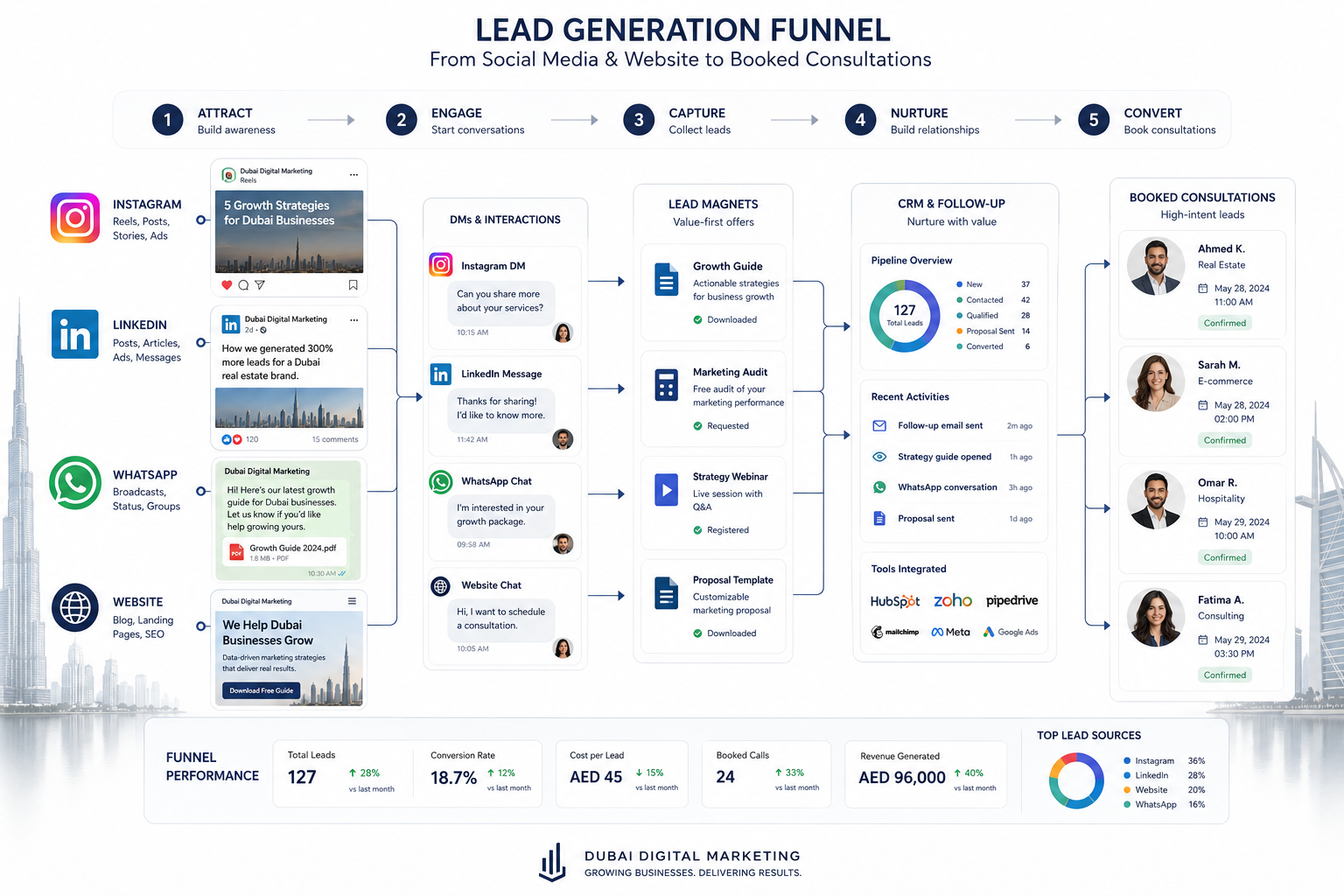
Step 1: Turn Your Profile Into a Conversion Entry Point
The profile is the first conversion layer.
Most businesses treat bios, highlights, and profile descriptions as informational sections. In practice, these elements operate as decision filters.
Users decide within seconds whether to continue engaging or leave.
Because of that, profiles should communicate a clear offer immediately.
On Instagram, this means simplifying the profile structure.
Instead of broad descriptions such as “we do social media,” stronger profiles communicate a direct outcome. Highlights should reinforce trust through client results, testimonials, FAQs, and lead-focused entry points such as “Free Audit” or “Book Consultation.”
Instagram-focused lead generation research consistently shows that profiles convert better when the offer remains specific and the next action feels obvious:
Instagram Lead Generation Guide
LinkedIn requires a different approach.
Instead of visual-first positioning, LinkedIn profiles should establish expertise, authority, and commercial relevance. Headlines, featured sections, and pinned posts need to communicate who the business helps, which problems it solves, and why the solution matters.
Strong LinkedIn lead generation strategies increasingly focus on ICP alignment, content positioning, and lead capture workflows rather than networking volume alone:
LinkedIn Marketing Strategy for B2B
Across all platforms, the principle remains consistent.
The profile should answer commercial intent immediately.
Visitors should not need to interpret the offer themselves.
Step 2: Build Lead Magnets and Offers Around Customer Intent
Most users do not convert during the first interaction.
Because of that, businesses need intermediate conversion points that capture interest before the purchasing decision happens.
This is where lead magnets become important.
Effective lead magnets provide immediate value while positioning the business as a trusted source. Instead of pushing direct sales immediately, they create low-friction entry points into the funnel.
For Dubai businesses, this can take different forms depending on the industry.
Consultants may offer free audits or downloadable frameworks. Real estate agencies may create area investment guides. Restaurants may promote private dining inquiries or event packages. Beauty clinics may provide consultation bookings or treatment preparation checklists.
The structure matters more than complexity.
Strong lead magnets solve a small but meaningful problem quickly.
At the same time, they help qualify the audience.
Research on modern lead generation strategies highlights that interactive offers, educational resources, and personalized entry points consistently outperform generic promotional messaging:
Warmly – Lead Generation Ideas
As a result, lead generation becomes more predictable because the audience enters the funnel intentionally rather than passively consuming content.
Step 3: Use Native Platform Tools to Capture Leads Directly
Most social platforms already include lead generation tools.
However, many businesses still redirect users unnecessarily or rely entirely on manual conversations. As a result, potential leads drop out before completing the process.
Native lead tools reduce that friction.
Instagram lead forms, LinkedIn Lead Gen Forms, story stickers, booking buttons, and direct inquiry features allow businesses to capture intent while the user is still engaged.
This matters because attention moves quickly on social media.
When users need to leave the platform, search for information, or navigate through multiple pages, conversion rates often decline.
Therefore, the goal should be to shorten the path between interest and action.
Instagram provides several strong conversion points.
Story replies create conversational entry points. Lead ads capture contact information directly inside the platform. CTA buttons simplify bookings and inquiries. In addition, highlights can guide users toward testimonials, service explanations, and offers without requiring website navigation.
LinkedIn functions differently because intent tends to be more commercial and relationship-driven.
Lead Gen Forms allow businesses to collect inquiries without redirecting users externally. At the same time, content itself becomes part of the qualification process. Educational posts, case studies, and opinion-driven content attract audiences already aligned with the business focus.
As a result, lead quality often improves before outreach even begins.
Research on B2B lead generation strategies shows that platform-native tools combined with targeted positioning significantly improve conversion efficiency:
LinkedIn Marketing Strategy for B2B
The same principle applies across other channels.
TikTok inquiry flows, Facebook lead forms, WhatsApp integrations, and Google Business messaging all create opportunities to capture intent earlier in the process.
Businesses that simplify these pathways generate more consistent inquiries.
Step 4: Build Follow-Up Systems Instead of Relying on Manual Replies
Generating leads is only part of the process.
Without structured follow-up, many opportunities disappear before conversations develop.
This is one of the biggest gaps across social media strategies.
Businesses invest heavily in content creation yet respond inconsistently to inquiries. DMs remain unanswered. Leads wait too long for replies. Conversations lose momentum.
As a result, conversion drops even when visibility performs well.
Structured follow-up systems solve this issue.
The goal is not aggressive automation. The goal is maintaining continuity after the initial interaction.
For example, Instagram inquiries can trigger WhatsApp conversations, CRM entries, or email follow-up sequences. LinkedIn lead form submissions can connect directly to sales pipelines or consultation booking systems.
At the same time, unified inbox systems simplify communication management across multiple channels.
Research on social media lead generation increasingly highlights the role of CRM integrations, chat workflows, and centralized messaging systems in improving conversion consistency:
Trengo Social Media Lead Generation Strategies
For Dubai businesses, response speed becomes especially important.
Customers often compare multiple providers simultaneously. Delayed responses create immediate competitive disadvantages because alternatives remain easily accessible.
Therefore, businesses that maintain faster and more structured communication frequently outperform larger competitors with slower systems.
Step 5: Measure Leads, Not Engagement Alone
Social media metrics often create misleading performance signals.
High reach, strong engagement, and increasing follower counts can create the impression of growth even when lead generation remains weak.
Because of that, businesses need to shift measurement priorities.
The key question is not how many people interacted with the content.
The key question is how many qualified leads entered the pipeline.
This changes how performance should be evaluated.
Instead of focusing only on likes or impressions, businesses should monitor:
- DM inquiries
- lead form submissions
- consultation bookings
- WhatsApp conversations
- email signups
- conversion rates by platform
These metrics connect social activity to business outcomes.
At the same time, different platforms should be evaluated differently.
Instagram may generate higher inquiry volume through stories and reels. LinkedIn may generate fewer leads overall but stronger commercial intent. TikTok may create discovery momentum that later converts through other channels.
Understanding these differences improves allocation decisions.
As a result, businesses stop chasing vanity metrics and begin optimizing for actual acquisition.
Why Social Media Lead Generation Requires Ecosystems, Not Isolated Posts
Individual posts rarely create predictable lead flow on their own.
Consistency comes from systems.
Profiles, offers, lead magnets, follow-up workflows, and platform tools all need to work together. When these elements align, social media becomes more than a visibility channel.
It becomes part of the acquisition infrastructure.
This is especially important in Dubai, where competition across industries continues increasing and customer attention remains fragmented.
Businesses that rely only on posting frequency often struggle to convert attention into revenue. Meanwhile, businesses that build lead generation systems create more stable growth patterns over time.
The difference is structural.
Visibility attracts attention.
Systems convert it.
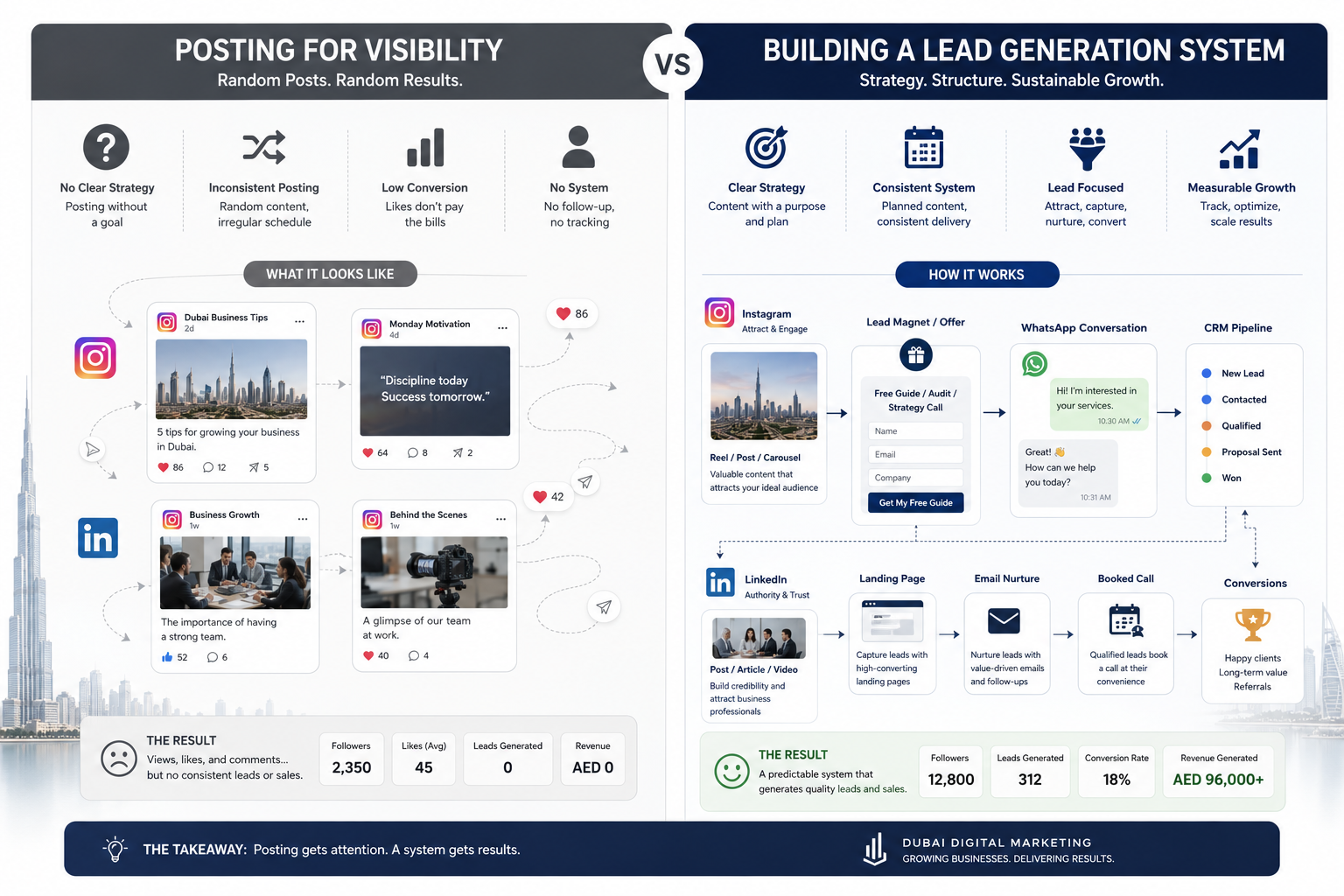
How MG Lumeo Approaches Social Media Lead Generation
Most businesses already generate attention online.
The real challenge is turning that attention into a structured pipeline.
At MG Lumeo, social media is not approached as isolated content production. The focus is on building systems that connect visibility, positioning, lead capture, and follow-up into one measurable process.
That distinction changes how platforms are used.
Instead of posting simply to maintain activity, every element is designed to support movement through the funnel. Profiles communicate a clear offer. Content reinforces expertise and trust. Lead magnets create entry points. Follow-up systems maintain momentum after the first interaction.
As a result, social media becomes commercially functional rather than performative.
This approach also recognizes that different platforms play different roles.
Instagram works strongly for visual trust, discovery, and conversational engagement. LinkedIn performs differently because users arrive with more commercial intent and decision-making context. Meanwhile, platforms such as TikTok, Google Business Profile, and WhatsApp often support visibility and conversion at different stages of the journey.
Because of that, strategy cannot remain identical across channels.
The structure needs to reflect user behavior.
For example, a Dubai restaurant may use Instagram to generate demand through visual storytelling while relying on WhatsApp inquiries and booking flows for conversion. A consultant may use LinkedIn thought leadership to build authority while guiding leads toward discovery calls or downloadable resources.
The platforms differ, but the system remains connected.
Another important factor involves speed and consistency.
Dubai customers operate in highly competitive environments where alternatives are always available. Delayed responses, unclear offers, and disconnected messaging reduce trust quickly.
Therefore, lead generation systems must reduce friction at every stage.
That includes:
- clear positioning
- strong calls to action
- simplified inquiry paths
- structured follow-up workflows
- consistent messaging across platforms
When these elements align, social media performance becomes easier to measure and optimize.
Instead of relying on assumptions, businesses can identify which platforms generate qualified leads, which content drives inquiries, and where conversion bottlenecks exist.
Over time, this creates more predictable acquisition patterns.
Why Lead Generation Is Replacing Vanity Metrics
The social media landscape has changed significantly.
Follower counts and engagement metrics still matter, yet they no longer provide a complete picture of performance. Businesses increasingly prioritize conversion quality over visibility alone.
This shift reflects broader market behavior.
Customers now move across multiple platforms before making decisions. They discover businesses through reels, evaluate credibility through LinkedIn, check reviews on Google, and continue conversations through WhatsApp or DMs.
Because of that, social media should be evaluated as part of the sales process rather than isolated marketing activity.
The businesses growing consistently understand this transition.
They do not rely only on content volume. Instead, they build ecosystems where every platform contributes to lead generation in a specific way.
That structure creates stronger long-term performance because visibility connects directly to measurable business outcomes.
Final Perspective
Social media alone does not generate predictable growth.
Lead generation systems do.
Businesses that treat Instagram, LinkedIn, and other platforms only as content channels often struggle to convert attention into revenue. Meanwhile, businesses that build structured conversion pathways create more stable acquisition pipelines.
The difference comes from how the platforms are used.
Strong profiles create clarity. Lead magnets capture intent. Native tools reduce friction. Follow-up systems maintain momentum. Measurement connects activity to business performance.
Together, these elements transform social media from visibility into infrastructure.
In Dubai’s competitive environment, that distinction becomes increasingly important.
Customers move quickly, compare constantly, and expect seamless digital experiences across every touchpoint. Businesses that simplify the journey gain a measurable advantage.
The goal is no longer only to stay active online.
The goal is to build social media systems that consistently generate qualified leads.

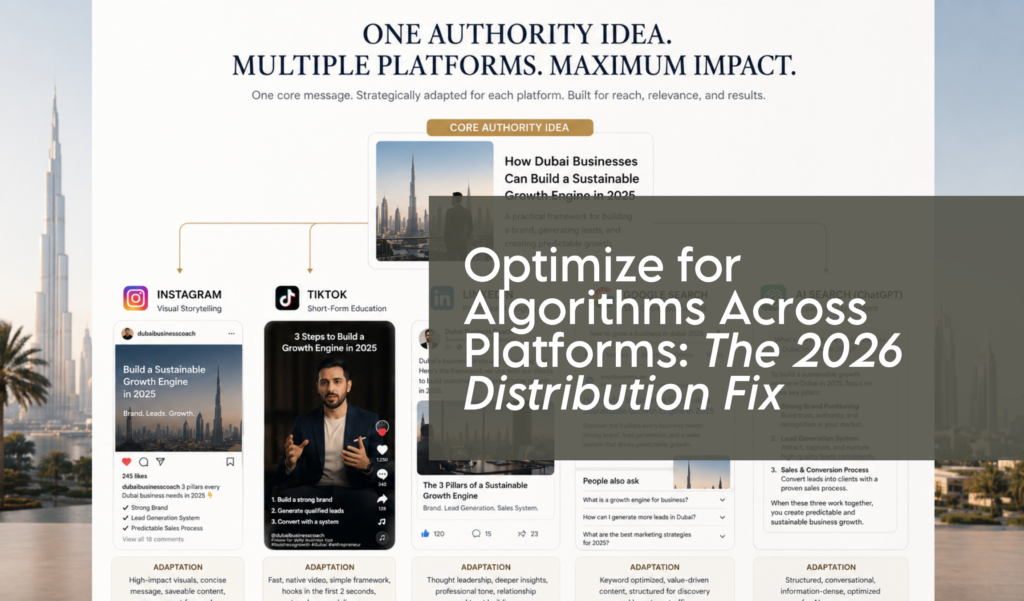

Social Profiles