(ChatGPT, Gemini, Perplexity and More)
Why AI Visibility Is Becoming the Next Competitive Layer
Search behavior is changing faster than most businesses realize.
Customers are no longer relying only on Google search results. Instead, they increasingly ask ChatGPT, Gemini, Perplexity, and AI-powered search tools for recommendations, comparisons, and local business suggestions.
That shift changes how visibility works.
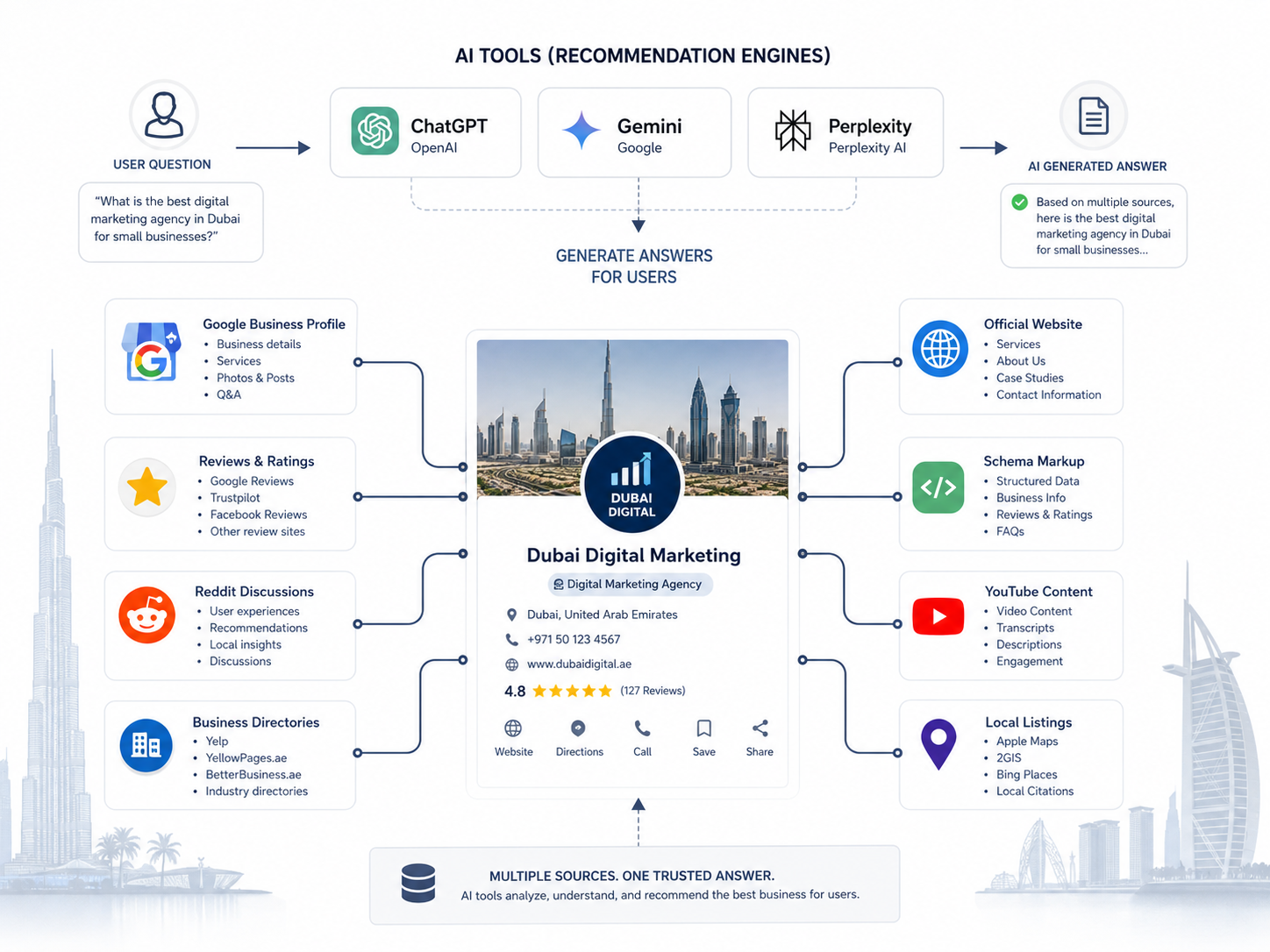
Instead of clicking through ten blue links, users now receive direct answers generated from multiple online sources. Businesses appear inside those answers through citations, mentions, entity recognition, and structured data signals.
As a result, ranking on Google alone is no longer enough.
Businesses now need to optimize for how AI systems interpret credibility, authority, and local relevance.
This is where Generative Engine Optimization, or GEO, becomes important.
However, advanced GEO goes far beyond traditional SEO tactics.
Keyword repetition alone does not influence AI visibility consistently. Instead, AI systems prioritize businesses that demonstrate strong entity signals, structured information, authoritative mentions, and contextual trust across the web.
This becomes especially important in Dubai.
The UAE continues positioning itself as a global AI hub, which accelerates both AI adoption and AI-driven search behavior across industries:
Gulf News – UAE Among Leading Global AI Hubs
As adoption increases, businesses that appear inside AI-generated answers gain a significant visibility advantage.
In practice, AI tools already influence local discovery across beauty, hospitality, consulting, and real estate. Customers increasingly search conversationally using prompts such as:
- best bridal salon in JLT
- Dubai Marina restaurant for business dinners
- luxury rental agent Downtown Dubai
AI systems then assemble recommendations from trusted sources, structured business data, reviews, directories, content authority, and entity consistency.
Because of that, businesses with stronger GEO foundations appear more frequently inside recommendations.
The key difference is important.
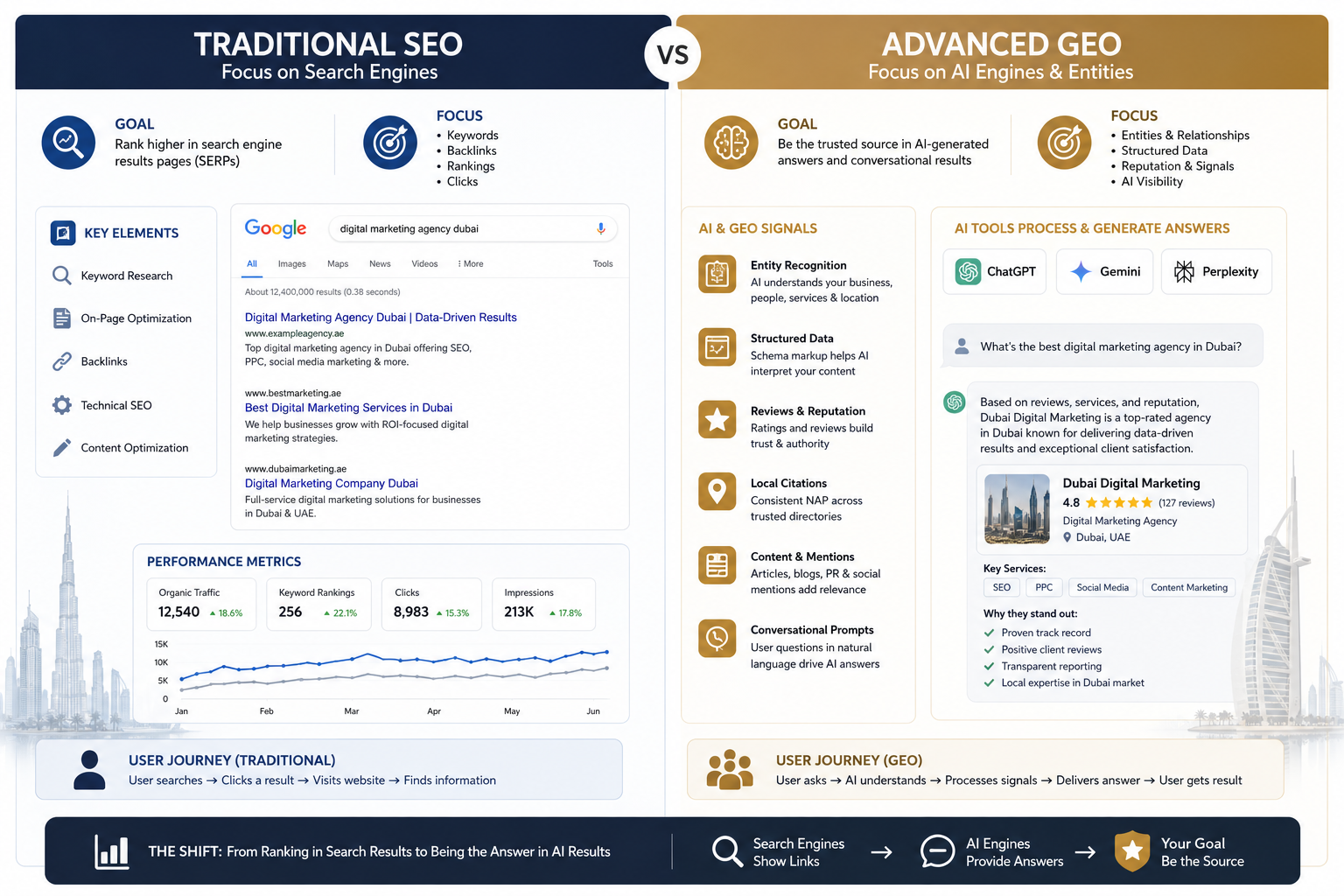
Traditional SEO focuses on ranking pages.
Advanced GEO focuses on becoming a recognized entity inside AI systems.
Step 1: Audit Your Current AI Visibility
Before optimizing, businesses need to understand how AI tools currently perceive them.
Most companies assume they appear in AI-generated answers simply because they rank on Google. In reality, many businesses have almost no AI visibility at all.
The fastest way to identify gaps is through direct testing.
Search your main commercial queries inside ChatGPT with browsing enabled, Gemini, Perplexity, and Google AI Overviews. Use prompts that reflect real customer behavior rather than branded searches.
For example:
- best Dubai Marina restaurant for corporate dinners
- top bridal salon Jumeirah
- trusted luxury rental agent Downtown Dubai
Then document four things:
- whether your business appears
- which competitors appear instead
- what sources AI tools cite
- how your brand is described
This process reveals how AI systems currently categorize your business.
In many cases, the issue is not quality. The issue is missing entity signals.
Businesses often discover that AI tools cite directories, review platforms, local listings, Reddit discussions, and structured articles more frequently than business homepages themselves.
Therefore, visibility depends on ecosystem presence rather than isolated website optimization.
Step 2: Build a Strong Local Entity Across the Web
Entity optimization forms the foundation of advanced GEO.
AI systems identify businesses as entities, meaning they evaluate consistency across platforms rather than relying only on keywords.
Because of that, business information must remain aligned everywhere it appears.
Name, address, phone number, website URLs, category descriptions, and business positioning should match across all platforms.
This includes:
- Google Business Profile
- Zomato and Talabat for restaurants
- Bayut and Dubizzle for real estate
- beauty and wellness directories
- LinkedIn company pages
- local UAE listing sites
Comprehensive UAE business listing sources also strengthen citation consistency:
Top UAE Local Citation Sites
Consistency matters because AI systems aggregate information from multiple locations simultaneously.
When descriptions vary heavily across platforms, entity confidence weakens.
When information aligns clearly, recognition strengthens.
This is particularly important for Dubai businesses competing inside dense local markets.
A salon described differently across Instagram, Google, and booking platforms creates ambiguity. A restaurant positioned inconsistently across review sites weakens topical authority.
Meanwhile, businesses with consistent entity structures become easier for AI systems to classify and recommend.
Step 3: Create Citation-Worthy Content, Not Generic Blog Posts
Most businesses misunderstand what AI systems actually favor.
AI tools do not prioritize content simply because it exists. Instead, they prioritize content that directly answers user intent with structure, clarity, and contextual depth.
As a result, short promotional articles rarely perform well inside AI-generated answers.
Citation-worthy content behaves differently.
It answers highly specific questions clearly and comprehensively. It includes contextual details, practical examples, local relevance, structured formatting, and original insights.
For Dubai businesses, this creates a major opportunity.
Instead of publishing generic content like “best beauty salon services,” stronger GEO content targets conversational prompts directly.
For example:
- How to choose a bridal makeup artist in Dubai Marina
- Best areas in Dubai for long-term luxury rentals
- What corporate clients expect from private dining restaurants in DIFC
AI systems favor content that mirrors how people naturally ask questions.
Additionally, structured answer sections improve citation probability significantly.
One effective strategy involves creating short “answer capsules” directly below headings. These concise sections answer the question immediately before expanding into deeper context.
That structure improves AI extraction.
At the same time, adding unique observations, local examples, statistics, or operational insights increases authority signals further.
Generic summaries can be reproduced anywhere.
Original expertise cannot.
Step 4: Use Structured Data to Help AI Systems Understand Your Business
AI tools rely heavily on structure.
Even strong content becomes difficult to interpret when business information lacks clear formatting. Structured data solves this problem by helping search engines and AI systems understand what the business represents, where it operates, and which services it provides.
This is where schema markup becomes important.
For Dubai businesses, LocalBusiness schema, FAQ schema, and review markup strengthen contextual understanding significantly. These elements help AI systems connect services, locations, reviews, pricing, and topical relevance into one identifiable entity.
Without schema, AI tools rely more heavily on fragmented interpretation.
With schema, information becomes easier to classify and retrieve.
For example, a restaurant in DIFC can structure content around:
- business category
- location coordinates
- operating hours
- reservation details
- customer reviews
- FAQ sections
As a result, AI systems gain clearer signals regarding the business and its relevance to conversational prompts.
FAQ schema becomes especially useful for GEO.
AI systems frequently pull direct answers from structured FAQ sections because the format mirrors conversational search behavior. Questions such as “What is the best area for luxury rentals in Dubai?” or “How far in advance should bridal makeup be booked in Dubai?” become easier for AI systems to extract and cite when properly structured.
At the same time, schema improves visibility across Google rich results and AI-powered summaries.
Businesses that structure their information clearly increase the likelihood of appearing not only in traditional search results, but also in AI-generated recommendation layers.
Step 5: Build Multi-Platform Signals AI Systems Already Trust
AI visibility does not come from websites alone.
Modern AI tools aggregate information from multiple ecosystems simultaneously. Reviews, forum discussions, directory listings, social content, and video transcripts all contribute to how businesses are interpreted.
Because of that, businesses need broader digital presence signals.
Google Business Profile remains one of the strongest local trust signals. Reviews, updated photos, categories, and customer engagement all contribute to AI visibility.
However, additional platforms now influence recommendations as well.
Reddit discussions frequently appear inside AI-generated answers because they provide conversational context. Quora responses contribute topical authority. YouTube transcripts strengthen contextual relevance for tutorials, local recommendations, and educational searches.
In practice, AI systems often combine multiple sources before generating recommendations.
For example, a Dubai restaurant might appear inside AI responses because:
- its Google reviews are strong
- its Zomato profile is active
- its Instagram location receives tags
- Reddit users discuss the experience positively
- YouTube creators mention the venue
Together, these signals reinforce trust.
This creates an important shift in how businesses should approach digital visibility.
Instead of focusing only on website traffic, businesses now need ecosystem recognition. AI systems reward brands that appear consistently across trusted platforms.
Therefore, GEO strategy should include:
- Google review generation
- community mentions
- video content with transcripts
- forum participation
- directory optimization
- localized social engagement
Strong multi-platform signals increase the probability of AI citation significantly.
Step 6: Create Hyper-Local Content AI Systems Can Reference
Generic local content rarely performs well in advanced GEO.
AI systems increasingly prioritize specificity, especially for commercial and location-based searches. Because of that, neighborhood-level authority becomes extremely valuable in Dubai.
Most businesses still optimize broadly for “Dubai.”
However, AI tools increasingly respond to highly localized prompts such as:
- best salon in JLT for bridal makeup
- DIFC restaurant for business meetings
- luxury rentals near Dubai Marina metro
These prompts require contextual relevance beyond city-level optimization.
Hyper-local GEO solves this problem.
Instead of creating generic service pages, businesses should build location-specific content tied to real customer behavior. A restaurant can publish guides around corporate dining in DIFC. A salon can create wedding preparation content tied to Jumeirah venues. A real estate agency can publish investment insights specific to Downtown Dubai or Palm Jumeirah.
This level of specificity improves citation potential because AI systems prefer highly contextual answers.
Additionally, original local content strengthens trust signals.
Unique photos, operational insights, neighborhood trends, local statistics, and firsthand observations create content AI systems cannot easily replace with generic summaries.
That distinction matters.
AI systems increasingly favor original context over repetitive SEO content.
Meanwhile, businesses relying on generic city-level pages become harder to differentiate.
Step 7: Monitor and Refine AI Visibility Continuously
Advanced GEO requires ongoing testing.
AI-generated answers evolve constantly because the underlying models, search integrations, and citation sources change continuously.
As a result, businesses should monitor AI visibility regularly rather than treating GEO as a one-time optimization project.
The process starts with recurring audits.
Every two weeks, businesses should test their core commercial prompts across ChatGPT, Gemini, Perplexity, and Google AI Overviews. The goal is not only to track visibility, but also to understand:
- which sources AI tools reference
- how competitors appear
- which content formats are cited
- whether sentiment changes over time
This reveals where authority signals are strengthening or weakening.
For example, a business may discover that competitors receive more citations because their Google reviews include photos, their Reddit discussions appear frequently, or their service pages answer conversational queries more directly.
These insights create actionable GEO adjustments.
At the same time, AI visibility tracking helps businesses identify emerging opportunities before competitors adapt. Conversational search patterns change rapidly, especially in Dubai’s fast-moving sectors such as beauty, hospitality, and real estate.
Businesses that refine GEO consistently gain long-term discoverability advantages.
Those advantages compound over time because AI systems reinforce entities they already recognize confidently.
How MG Lumeo Approaches Advanced GEO for Dubai Businesses
Most businesses still approach visibility through a traditional SEO mindset.
The focus stays on rankings, keywords, and traffic volume. While these elements still matter, they no longer explain how businesses appear inside AI-generated recommendations.
AI discovery works differently.
Instead of evaluating isolated pages alone, AI systems analyze broader trust ecosystems. They assess entities, contextual authority, platform consistency, structured data, local relevance, and recurring mentions across the web.
Because of that, advanced GEO requires a more integrated strategy.
At MG Lumeo, the process starts with understanding how AI systems currently interpret the business.
This includes auditing entity consistency, conversational visibility, citation sources, local authority signals, and platform alignment. Rather than focusing only on search rankings, the goal is to identify how often the business appears inside recommendation-based queries.
From there, the strategy expands across multiple layers.
Structured content is developed around real conversational prompts. Local authority signals are strengthened through directories, review ecosystems, and platform consistency. Schema markup is implemented to improve contextual understanding. At the same time, hyper-local content builds neighborhood-level relevance across Dubai.
However, advanced GEO is not only technical.
Authority plays a major role.
AI systems consistently favor businesses that demonstrate expertise clearly across multiple touchpoints. Because of that, educational content, original insights, operational transparency, and consistent positioning all contribute to stronger AI visibility over time.
This becomes especially important in competitive Dubai industries.
Beauty clinics, restaurants, real estate agencies, consultants, and service providers often compete within highly saturated digital environments. Under these conditions, businesses that build stronger entity recognition gain a long-term advantage inside AI-generated discovery systems.
That advantage compounds.
Once AI systems repeatedly recognize a business as a trusted entity within a niche or location, recommendation frequency increases naturally. Over time, this creates stronger visibility without relying entirely on paid traffic.
Why GEO Is Becoming a Long-Term Visibility Strategy
AI search behavior continues evolving rapidly.
Customers increasingly expect direct answers instead of long search journeys. Rather than browsing multiple websites, users ask conversational questions and rely on AI-generated summaries to filter options.
As a result, discoverability shifts from ranking pages to becoming a recognized recommendation source.
This changes how businesses should think about content, authority, and digital presence.
Businesses that optimize only for traditional SEO may still generate traffic. However, businesses that optimize for GEO increase the likelihood of appearing directly inside AI-generated answers.
That distinction becomes critical as conversational search adoption grows.
For Dubai businesses, this creates both pressure and opportunity.
The market already operates at high digital maturity. Competition is intense, customer expectations are elevated, and local discovery patterns evolve quickly. Businesses that adapt early to AI-driven discovery systems position themselves ahead of slower competitors.
Meanwhile, businesses that ignore GEO risk losing visibility even when their services remain strong.
The shift is already happening.
AI tools now influence how customers discover restaurants, compare salons, evaluate agencies, research real estate, and shortlist service providers.
Visibility inside those systems will increasingly shape commercial growth.
Final Perspective
Getting mentioned by AI tools is no longer accidental.
AI systems favor businesses that demonstrate clear entity signals, structured information, strong authority, and consistent contextual relevance across the web.
Because of that, advanced GEO requires more than basic SEO tactics.
Businesses need structured ecosystems that combine content, local authority, schema markup, reviews, platform consistency, and conversational relevance.
In Dubai, where digital competition moves quickly, these signals become even more important.
Customers increasingly rely on AI-generated answers to filter choices, compare businesses, and make decisions faster. As this behavior grows, discoverability will depend less on isolated rankings and more on entity recognition.
Businesses that AI systems recognize consistently will dominate recommendation-based visibility.
The goal is no longer only to rank.
The goal is to become a trusted source AI tools choose to reference.


Social Profiles