Vague Offers Lose Clients in Dubai
Dubai businesses rarely struggle with visibility.
Salons post daily on Instagram. Restaurants invest in visuals and influencer collaborations. Real estate agents run paid campaigns across multiple platforms. Attention exists, and in many cases, traffic does as well.
However, conversions often remain inconsistent.
Customers visit profiles, explore websites, and even make initial inquiries. Then the process stops. Bookings do not happen. Leads do not move forward. Interest does not turn into action.
The issue does not come from lack of marketing activity. Instead, it comes from how the offer is presented.
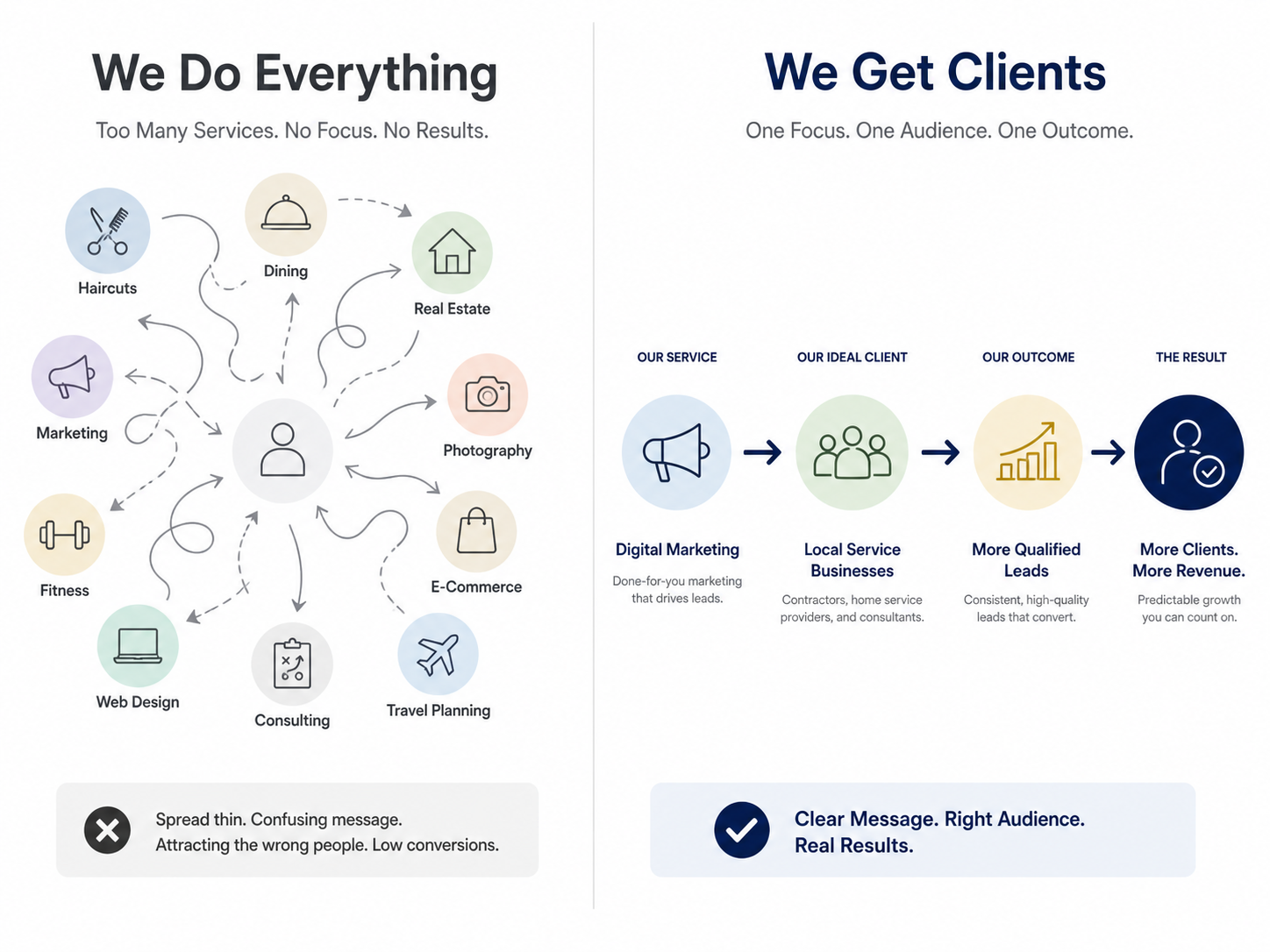
When a business communicates “we do everything,” it creates uncertainty. The customer has to interpret what is relevant, what result to expect, and whether the service fits their situation. In a fast-moving market, that extra step leads to hesitation.
As a result, the customer moves on.
This behavior is amplified in Dubai.
Competition is high, expectations are shaped by premium experiences, and options are always available. Because of that, customers rely on quick signals to decide. They do not analyze deeply. They scan and filter.
Therefore, clarity becomes a competitive advantage.
Across Industries, the Pattern Remains the Same
The impact of unclear positioning appears across different sectors, even though the services differ.
In the beauty industry, salons that focus on specific outcomes such as bridal preparation or premium treatments attract more qualified clients than those presenting a full list of services. Local data shows that niche positioning combined with strong reviews and visibility drives the majority of new client acquisition in Dubai salons:
Areesto – Increase Sales in Dubai Salons
Restaurants follow a similar dynamic.
According to UAE data, 74 percent of diners discover restaurants through Instagram, while direct bookings through the platform continue to grow:
SevenRooms UAE Trends 2025
At the same time, discovery alone does not guarantee bookings. Restaurants that communicate a clear experience such as corporate dining or private events convert more consistently than those offering broad, undefined menus.
Real estate shows the same pattern at a higher level.
While most inquiries originate online, conversion depends on positioning and trust. Data indicates that agents who focus on defined segments such as luxury rentals or investment properties achieve stronger conversion performance than generalists:
Promodo Real Estate Benchmarks
Across all three industries, the same outcome appears.
Visibility exists. Interest exists. Conversion does not follow.
Why “We Do Everything” Weakens Trust
Offering more does not increase demand.
In practice, a broad offer reduces clarity. When a message tries to address everyone, it becomes less relevant to each individual customer. Instead of feeling understood, the customer feels uncertain.
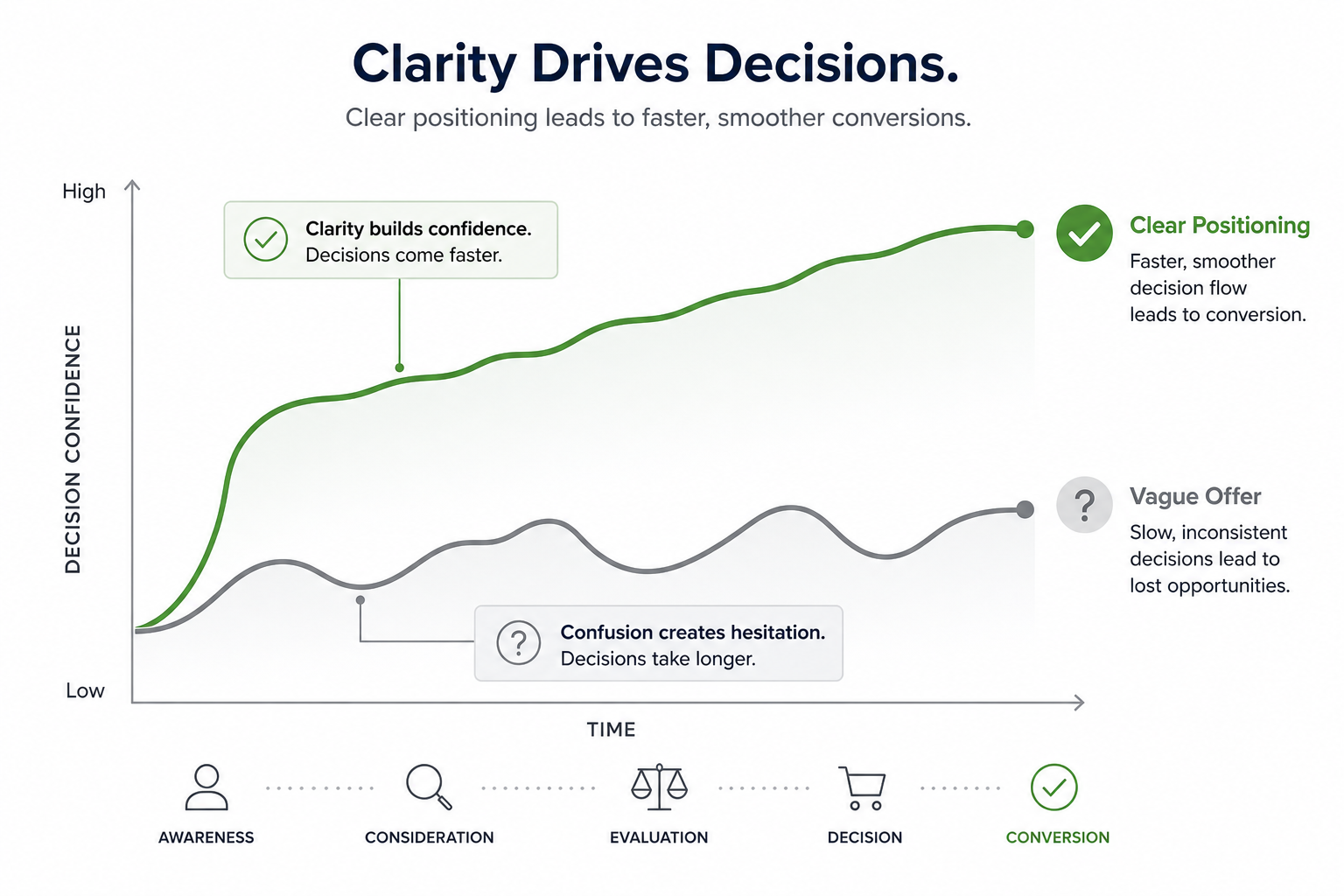
Uncertainty delays decisions.
In Dubai, delayed decisions usually lead to lost opportunities because alternatives are always available. Customers expect clear positioning, direct communication, and defined outcomes.
Therefore, specificity builds trust faster than variety.
In real estate, buyers rarely look for a general agent. They look for someone who understands a specific segment, whether that is off-plan investment or luxury leasing. Industry insights confirm that brokerage performance increasingly depends on specialization and targeted expertise:
Khaleej Times Brokerage Trends
The same logic applies across other sectors.
A salon that offers every service competes on convenience and price. In contrast, a salon focused on event-ready results competes on confidence and outcome.
A restaurant that lists multiple cuisines competes for attention. On the other hand, a restaurant built around corporate dining or private experiences competes for bookings.
Because of that, positioning directly influences how fast a customer decides.
Clarity Reduces Decision Time
Strong positioning simplifies the decision process.
Instead of asking questions, the customer immediately understands whether the service is relevant, what result to expect, and why it is worth choosing.
As a result, the path from interest to action becomes shorter.
Without that clarity, even strong marketing efforts lose effectiveness.
Paid campaigns can generate traffic. Social media can create engagement. Word of mouth can build awareness. However, vague offers limit conversion at every stage.
Therefore, positioning connects visibility to revenue.
A well-defined offer does not restrict a business. It focuses demand and attracts the right clients.
How to Fix Your Offer Positioning: A Practical Framework
Improving positioning does not require new services.
Most businesses already deliver value. The issue comes from how that value is communicated. When the offer lacks structure, customers struggle to connect it to their own needs.
Because of that, the goal is not expansion. The goal is clarity.
A refined offer makes the decision easier for the right audience. It removes unnecessary interpretation and highlights a clear outcome.
Start by Identifying Where the Offer Creates Friction
The first step involves recognizing where the message feels broad or unclear.
In many cases, businesses present their services as a list. While this approach feels complete, it shifts the effort to the customer. Instead of understanding the value immediately, the customer has to interpret it.
That extra step slows decisions.
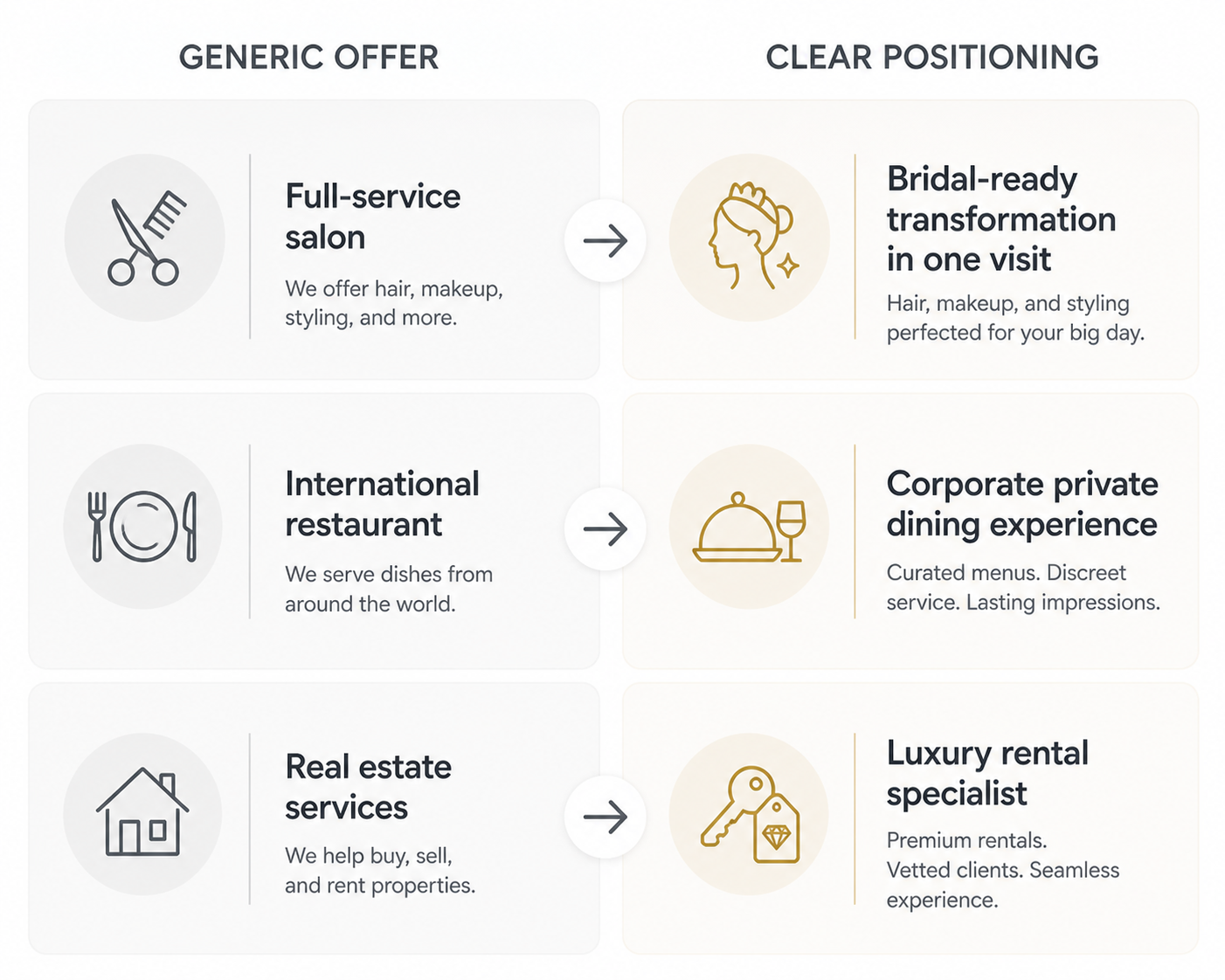
The difference becomes clear when comparing how the same service is positioned.
| Current Positioning | Refined Positioning |
|---|---|
| Full-service salon | Bridal-ready hair and makeup in one visit |
| International cuisine restaurant | Private dining experiences for corporate teams |
| Real estate services across Dubai | Luxury rental properties for high-net-worth clients |
The refined version removes ambiguity.
Instead of explaining everything, it highlights what matters most to a specific customer.
Translate Services Into Clear Outcomes
Customers focus on results, not processes.
A service describes what a business does. An outcome explains what changes for the client. That distinction shapes how the offer is perceived.
For example, a haircut represents a service. Wedding-ready styling represents a result. Property listings represent a service. Fast rental placement represents a result.
When the outcome is clear, the value becomes easier to understand.
Research on offer positioning shows that clearly defined outcomes improve conversion because they reduce the effort required for decision-making:
How to Reposition Your Offer
Therefore, strong positioning shifts the focus from features to results.
Narrow the Audience to Increase Relevance
Relevance drives attention.
When a message targets a specific group, it resonates faster. The customer recognizes the context and feels understood. As a result, trust builds earlier in the interaction.
In Dubai, where competition is intense, broad targeting often leads to weak positioning. Customers see similar messages across multiple businesses, which makes differentiation difficult.
Focusing on a defined audience changes that dynamic.
A salon targeting event preparation attracts clients looking for precision and reliability. A restaurant focusing on corporate bookings creates predictable demand. A real estate agent specializing in luxury rentals builds authority faster.
Specialization strengthens perception.
Data supports this approach, particularly in real estate, where targeted positioning leads to stronger conversion performance and higher-quality leads:
Real Estate Benchmarks
As a result, narrowing the audience increases effectiveness rather than limiting reach.
Support the Offer With Proof
Clarity attracts attention. Proof confirms decisions.
Before moving forward, customers look for evidence that the promised outcome is realistic. Without that confirmation, hesitation remains.
In Dubai, visual proof plays a central role.
Salons rely on before-and-after transformations. Restaurants benefit from tagged experiences and guest content. Real estate agents use case studies and successful transactions to build credibility.
Strong proof reduces uncertainty.
When customers see consistent results, they feel more confident choosing the service. As a result, conversion rates improve.
Industry data highlights how optimized profiles with strong reviews and visual validation convert significantly better than those without clear proof:
Dubai Salon Growth Insights
Align Positioning Across Every Channel
Consistency reinforces trust.
Customers interact with multiple touchpoints before making a decision. Search results, social media, and websites all contribute to the overall perception.
When the message changes across channels, confidence decreases.
When the message remains aligned, recognition increases.
For example, a restaurant positioned around corporate dining should reflect that focus across its Instagram content, booking system, and Google profile. A salon specializing in bridal services should reinforce that positioning through visuals, testimonials, and service descriptions.
Aligned messaging creates clarity.
Clarity builds trust.
Trust drives action.
From Positioning to Performance
Positioning is not a branding exercise.
It directly influences performance.
A clear offer reduces friction, attracts the right audience, and improves conversion across channels. Without that clarity, marketing efforts remain disconnected from results.
Businesses do not need to expand their services.
They need to communicate them with precision.
The shift from broad messaging to focused positioning is what turns visibility into consistent client acquisition.
How MG Lumeo Approaches Offer Positioning
Most businesses do not lack capability.
They lack clarity in how that capability is presented.
As a result, strong services fail to convert because the message does not reflect the value behind them.
At MG Lumeo, the focus is not on adding more marketing activity.
The focus is on structuring the offer so it connects directly with the right audience.
This approach starts by identifying where friction exists.
In many cases, businesses communicate too broadly. The message tries to cover multiple services, audiences, and outcomes at once. While this feels comprehensive, it creates hesitation at the decision stage.
Instead, the process narrows the focus.
The goal is to define a clear audience, a specific problem, and a measurable outcome. When these elements align, the offer becomes easier to understand and faster to act on.
From there, positioning is applied across every touchpoint.
Websites, landing pages, social media profiles, and ad campaigns follow the same direction. This consistency removes confusion and strengthens recognition.
At the same time, proof is integrated into the message.
Case studies, client results, and real examples reinforce the positioning. Instead of relying on claims, the offer is supported by evidence. This builds confidence early in the process.
As a result, the entire system becomes more effective.
Traffic converts more efficiently. Leads become more qualified. Sales cycles become shorter.
Why Structure Outperforms Tactics
Many businesses search for isolated improvements.
They test new ad formats, adjust targeting, or change creative direction. While these actions can create temporary results, they rarely solve the underlying issue.
Without structure, improvements remain disconnected.
A campaign may generate clicks, yet weak positioning prevents conversion. A strong lead may enter the funnel, yet unclear messaging delays the decision.
Structure connects these elements.
When positioning is clear, marketing channels reinforce each other. Each interaction moves the customer closer to a decision instead of creating additional questions.
This becomes especially important in Dubai.
The market evolves quickly. Competition increases continuously. Customer expectations remain high.
Under these conditions, clarity creates stability.
Businesses that communicate a clear offer maintain performance even when external factors shift. Customers recognize the value faster and respond with more confidence.
From Attention to Client Acquisition
Marketing generates attention.
Positioning converts that attention into action.
Without a clear offer, visibility remains disconnected from results. With strong positioning, each interaction contributes to client acquisition.
That shift changes how growth happens.
Instead of relying on constant effort, the business benefits from consistency. The message becomes easier to recognize. The audience becomes more aligned. Conversion becomes more predictable.
Over time, this creates a compounding effect.
Each interaction reinforces the same positioning. Each client experience supports the same outcome. Each channel contributes to the same direction.
Because of that, growth becomes structured rather than reactive.
Final Perspective
Dubai is not a market where vague positioning performs.
Customers expect clarity. They expect relevance. They expect confidence in what they are choosing.
Businesses that communicate broadly compete for attention.
Businesses that communicate clearly compete for decisions.
The difference between “we do everything” and “we get clients” comes down to positioning.
When the offer is clear, the right clients recognize it immediately.
When the message is focused, decisions happen faster.
When positioning aligns with real outcomes, marketing starts to work as expected.
That is where consistent growth begins.



Social Profiles