
Search engine optimization did not disappear in 2025.
It evolved.
What many brands and agencies are experiencing today is not the decline of SEO, but the end of a single, predictable search model. Visibility is no longer earned only through rankings and clicks. It is shaped by AI systems, zero-click results, experience signals, and discovery happening across multiple platforms.
According to recent industry analysis, AI-driven changes to search are expected to influence over $750 billion in revenue by 2028, making the evolution of SEO a strategic issue rather than a technical one (ALM Corp).
Understanding how SEO evolved is now essential for agencies that want to protect performance, retain trust, and build sustainable visibility for clients.
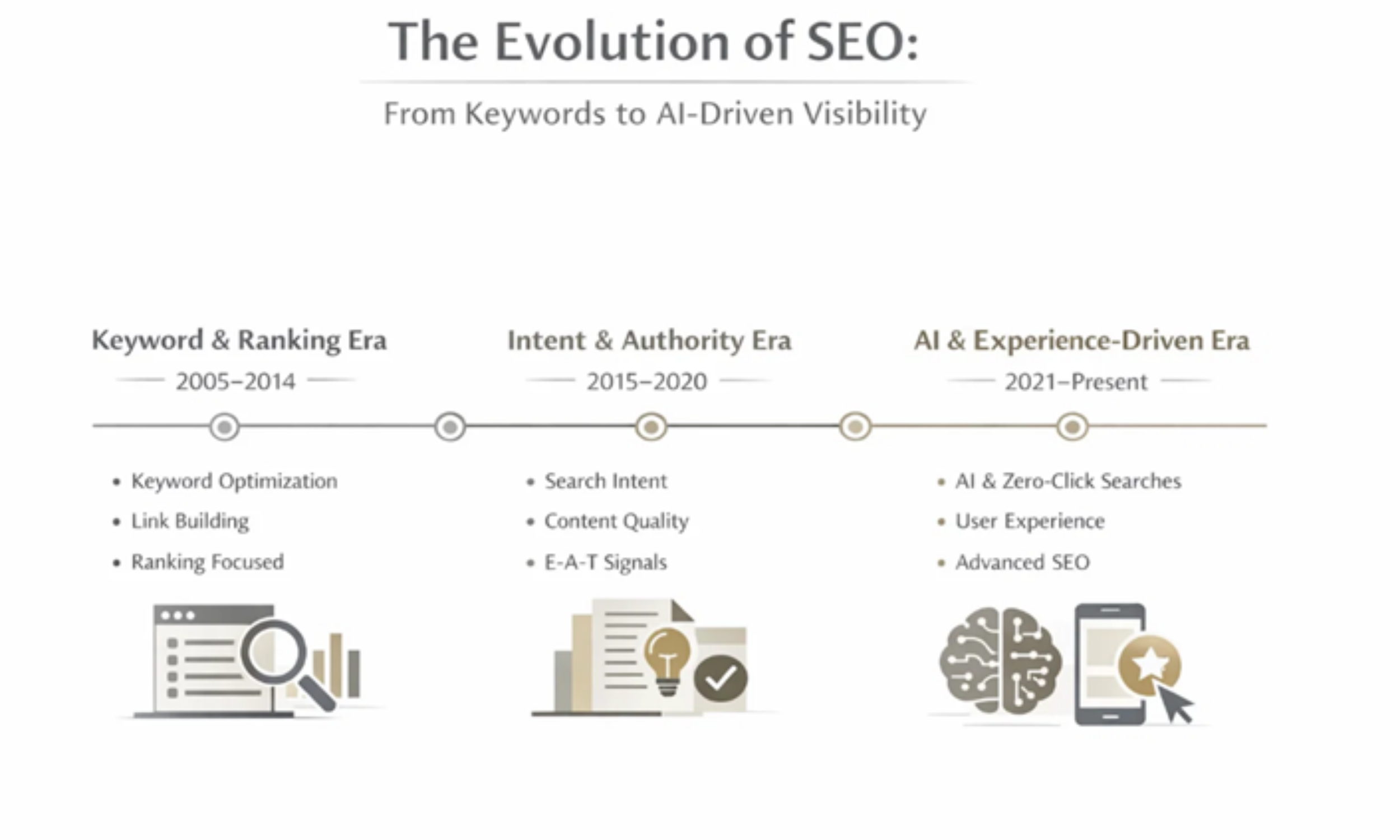
Phase One: The Keyword and Ranking Era
Early SEO was straightforward.
Success depended on identifying keywords, placing them correctly, building links, and climbing search engine results pages. Rankings were the primary metric. Traffic followed rankings. Conversions followed traffic.
For a long time, this model worked because search behavior was linear. Users typed a query, scanned results, clicked a link, and explored.
SEO during this phase was largely mechanical. It rewarded optimization tactics more than insight.
Phase Two: Intent and Authority Changed the Game
As search matured, keywords alone stopped being enough.
Google began prioritizing search intent, content quality, and authority. Topic clusters replaced single keywords. Content depth mattered more than repetition. User behavior started influencing rankings.
This shift laid the groundwork for E-A-T principles and later E-E-A-T, pushing brands to demonstrate credibility rather than just technical compliance.
SEO became less about manipulation and more about relevance.
Phase Three: AI, Zero-Click Search, and Experience (2024–2025)
The most significant evolution arrived with AI.
AI Overviews, featured answers, and zero-click results reshaped how users interact with search. Recent data shows that around 29 percent of search sessions are now affected by AI Overviews, reducing the need for users to click through to websites for basic information (ALM Corp).
At the same time, zero-click searches have surged by 69 percent since 2024, fundamentally changing how visibility works (ALM Corp).
This shift explains why many brands saw 30 percent or higher traffic drops on informational content, even when rankings remained stable (Concord USA).
SEO did not fail.
The click stopped being guaranteed.
E-E-A-T 2.0: Experience Becomes Non-Negotiable
In 2025, E-E-A-T evolved again.
Experience is no longer inferred from credentials or brand size. It is demonstrated through first-hand knowledge, real examples, and practical insight. Search engines increasingly favor content that proves it understands the subject in practice, not theory.
Recent SEO trend analysis highlights that experience now plays a stronger role than pure expertise, rewarding content grounded in real execution and lived insight (SFGate Marketing).
For agencies, this means content strategies need to reflect real work, not recycled summaries.
From Keywords to Intent and Sentiment
AI did not just change how results are shown. It changed how relevance is determined.
Modern SEO relies on intent and sentiment matching, not keyword density. AI systems interpret meaning, context, and emotional relevance, aligning content with what users are actually trying to solve.
Analysis of future SEO trends shows a clear move away from static keyword targeting toward contextual understanding and intent alignment, especially for informational and comparative queries (Exposure Ninja).
This evolution rewards clarity over volume.
Visibility Paradigms Have Shifted
SEO visibility in 2025 is no longer confined to blue links.
Modern visibility depends on:
- Topical authority rather than isolated pages
- Clear entities such as brands, products, and services
- Multimodal content combining text, visuals, and video
Research into SEO trends for 2026 shows that entity clarity and topical depth now play a central role in how search engines and AI systems surface content (Weventure).
This is where SEO begins to overlap with Generative Engine Optimization and Answer Engine Optimization.
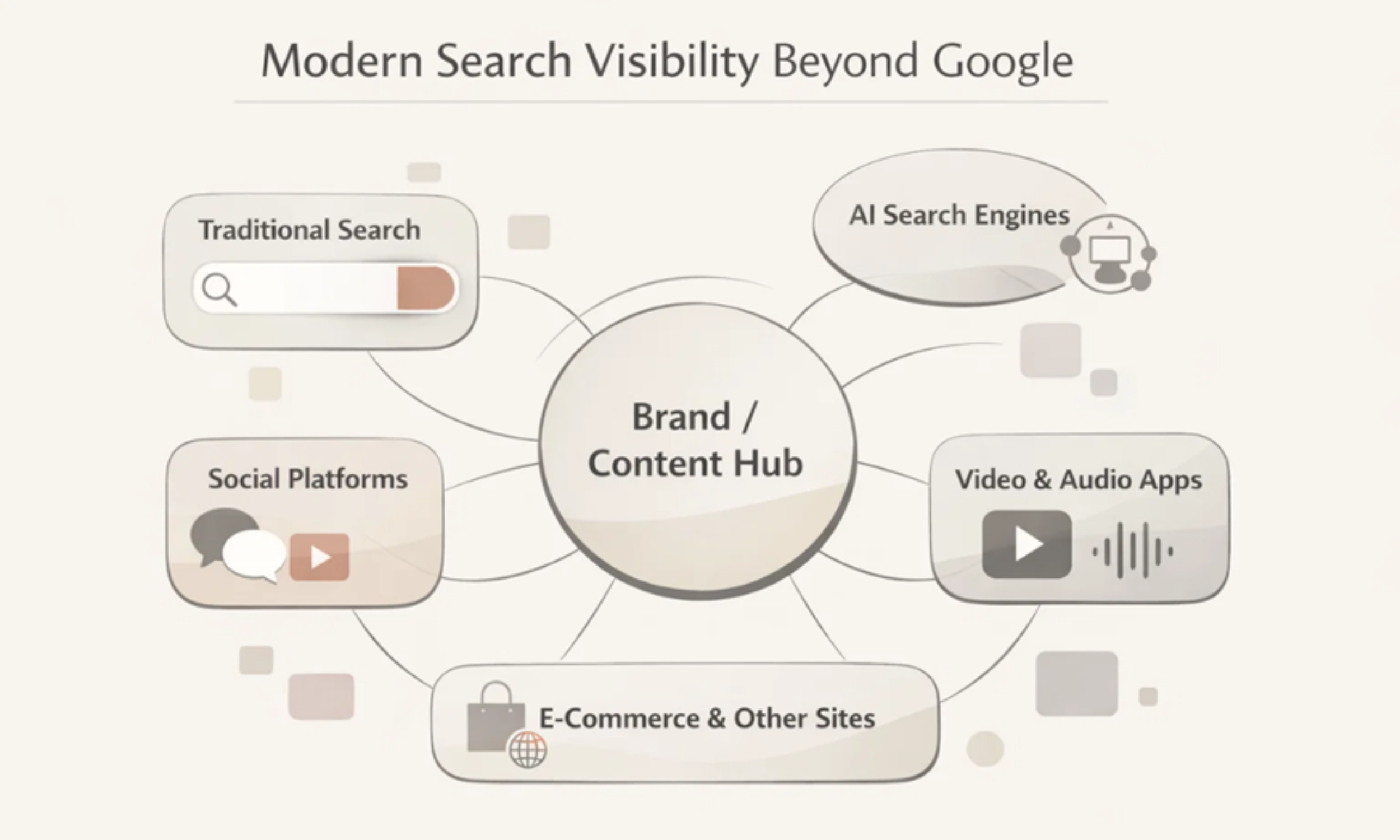
SEO Beyond Google: Discovery Has Expanded
Search no longer lives in one place.
Users increasingly move between Google, ChatGPT, Perplexity, and other AI-powered platforms depending on their needs. Informational discovery is fragmenting, while transactional intent still gravitates toward traditional search.
Analysis of AI SEO trends highlights the importance of traffic diversification beyond Google, especially as AI engines become common starting points for research (Mike Khorev).
Brands that rely solely on Google rankings expose themselves to unnecessary risk.
Metrics Have Changed and Agencies Must Adapt
Traditional SEO reporting focused on rankings, clicks, and CTR.
These metrics still matter, but they no longer tell the full story.
As zero-click searches increase, citations, visibility in AI responses, and assisted conversions are becoming more meaningful indicators of performance. Industry data suggests that brands failing to adapt to these new metrics risk up to 25 percent traffic loss over time (TheeDigital).
Modern SEO success is measured by influence, not just visits.
What SEO Really Means in 2025–2026
SEO today is not a channel.
It is a visibility system.
It includes:
- Traditional search optimization
- AI-driven discovery readiness
- Entity and authority building
- Content that supports decisions, not just answers
- Distribution beyond a single engine
This evolution does not reduce the importance of SEO. It expands its responsibility.
How Agencies Should Adapt
Agencies that succeed in this environment focus on structure rather than tactics.
They:
- Build authority around topics, not pages
- Align SEO with content and GEO strategies
- Track visibility across engines, not only rankings
- Treat experience as a competitive advantage
This approach allows SEO to remain effective even as platforms change.
How MG Lumeo Approaches Modern SEO
At MG Lumeo Digital, SEO is not treated as an isolated channel or a checklist of tactics. It is designed as part of a broader digital ecosystem where search, content, GEO, AI visibility, and performance analytics work together.
Search strategy is built around how people actually discover information today. That means understanding when users rely on traditional search, when they turn to AI-powered tools for answers, and how authority is formed across both. Rankings are considered, but they are not the end goal. The focus is on building long-term resilience, not chasing short-term gains that disappear with the next algorithm update.
SEO is used to capture high-intent demand where users are ready to act, while also strengthening topical authority that AI systems recognize and reference. Content is structured to be clear, contextual, and trustworthy, making it useful not only for search engines but also for generative models that synthesize information rather than list links.
Discovery is approached as a multi-platform reality. Visibility is supported across Google, AI-driven search experiences, and owned channels, reducing dependency on any single source of traffic. Performance is evaluated based on real business outcomes, not just traffic volume. Enquiries, conversions, and assisted impact matter more than raw clicks.
This approach allows SEO to remain effective as search continues to evolve. By aligning technical foundations, content strategy, and authority-building, MG Lumeo helps brands stay discoverable, credible, and relevant in a search landscape that no longer operates on rankings alone.
A Practical SEO Evolution Checklist for Brands and Agencies
SEO evolution does not require starting from zero. It requires clarity.
Ask:
- Does our content demonstrate real experience?
- Are our core topics structured for AI understanding?
- Are we visible beyond Google rankings?
- Do we measure authority, not just traffic?
Final Thoughts
SEO did not disappear.
It grew up.
As AI reshapes how information is discovered, agencies that understand SEO as an evolving system rather than a static discipline will continue to deliver value.
The future of SEO belongs to those who build clarity, authority, and trust across every place search happens.



Social Profiles